
How to Search Kansas Court Records
The Kansas District Court Public Access Portal is the main statewide index for district court case information. It can show a case number, parties, lawyers, case type, filing place, assigned judge, hearings, charges, financial entries, and public documents when available. It does not combine municipal court dockets, federal cases, jail rosters, or every historical document. Electronic images also depend on when the filing court joined Kansas eCourt and whether Rule 22 permits internet access. A missing document link can mean the item is older, courthouse-only, restricted, or sealed.
Start with a full case number whenever possible. A name search works, but common names can produce false matches. Add the filing county, date range, and case type, then compare every stable identifier that is lawfully displayed. The official Smart Search instructions explain exact-name and wildcard methods. Use the filing county's clerk of the district court for public documents that the portal does not deliver. Municipal ordinance cases stay with the city court, while federal matters use the federal judiciary.
- Identify the named court. Decide whether the matter is district, municipal, appellate, or federal before choosing a search system.
- Enter the full case number in Smart Search. If none is known, search the party or business name and narrow by court location, year, and case type.
- Open the likely Kansas case and compare its parties, filing place, status, and year. A name alone does not prove identity or outcome.
- Read the register of actions and each charge or judgment. Check the court's eCourt conversion date when a public document is not online.
- Use the county directory and ask the filing clerk for terminal access, an archived item, or a certified copy when legal proof is needed.
The Kansas Judicial Branch record-request instructions show why the correct filing office matters. The official source image below illustrates that county-based request route.
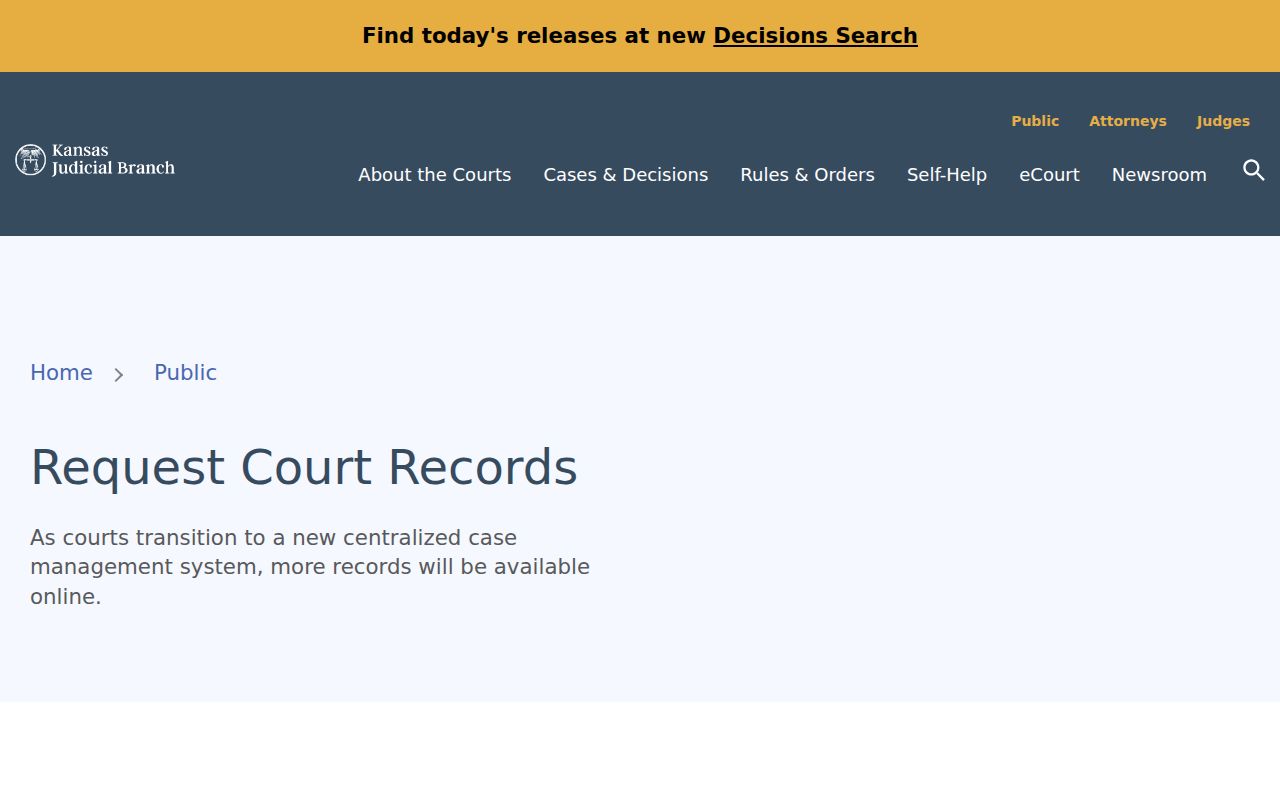
A portal printout helps locate a Kansas case, but only the custodian can issue a certified copy of the filed record.
Kansas Court Records by Court Level
Kansas operates one unified judicial branch under the Kansas Supreme Court's general administrative authority. The seven-justice Supreme Court is the court of last resort. Most appeals first reach the 14-judge Kansas Court of Appeals, a single statewide court whose three-judge panels can sit around Kansas. It does not have numbered geographic appellate districts. The Kansas court system includes 31 trial-court districts, yet each county retains its own district court location and clerk file.
District courts have general original jurisdiction. They hear state felonies and misdemeanors, civil actions, divorces, protection matters, probate, guardianship, juvenile cases, mental-health proceedings, small claims, and municipal appeals. District magistrate judges work inside that same court system and do not maintain a separate repository. Municipal courts are city courts. They decide ordinance violations, including many city traffic and lower-level offenses, and their original records do not automatically enter the statewide district portal.
Common appeal path: Municipal Court › District Court › Kansas Court of Appeals › Kansas Supreme Court. A district case normally begins at District Court and follows the last two levels, although law can send limited matters directly to the Supreme Court.
| Court | Jurisdiction | Case Types |
|---|---|---|
| Kansas Supreme Court | Final state review and court administration | Direct appeals set by law, review petitions, original writs, discipline |
| Kansas Court of Appeals | Statewide intermediate review | Most civil, criminal, and agency appeals from District Court |
| District Court | General trial jurisdiction in every county | Criminal, civil, family, probate, juvenile, small claims, municipal appeals |
| Municipal Court | City ordinance jurisdiction | City traffic, parking, code, DUI, and misdemeanor ordinance cases |
Kansas Court Record Types
Kansas District Court files reflect the branch's broad jurisdiction. Civil records may include petitions, answers, service returns, motions, judgments, garnishments, and satisfaction entries. Small claims and evictions use district procedures but follow narrower rules. Criminal files track allegations after filing, hearings, pleas, count-level outcomes, sentences, and later review. Family records include divorce, parentage, custody, support, and protection proceedings, though protected addresses and child data can be withheld. Probate files contain wills, appointment papers, notices, inventories, claims, and settlement orders. Juvenile, adoption, and mental-health records have tighter access rules.
- Criminal records track the filed case, not merely the arresting officer's initial allegation.
- Civil records cover disputes, small claims, evictions, judgments, liens, and postjudgment collection.
- Family records include divorce and parentage files, with sensitive financial and minor data protected.
- Probate records remain District Court records even when a county uses a probate division or docket.
- Traffic records may belong to a municipal court or District Court, depending on the printed citation.
A marriage license is also issued and kept by the clerk of the district court, not by the Kansas county clerk. Land instruments belong to the register of deeds, jail records belong to the sheriff, and county-government minutes and elections belong to the county clerk. Choosing by record type prevents a costly request to the wrong custodian.
What Kansas Court Records Show
A Kansas case summary may show the exact case number, county, case type, filing date, status, assigned judicial officer, parties, lawyers, hearings, financial entries, and document links. Criminal records may add each count, statute, severity, plea, amendment, disposition, and sentence. The register of actions lists filings and events in date order. It is an index, not a verbatim transcript. A scheduled hearing can change, a closed case can reopen, and one closed criminal file can contain both dismissed and convicted counts.
- Case number
- The Kansas eCourt identifier and any displayed legacy number used to locate the file.
- Filing date
- When the case opened, which differs from an offense, arrest, citation, marriage, death, or judgment date.
- Parties
- Names and procedural roles, such as plaintiff, petitioner, defendant, or respondent, plus public lawyer data.
- Charges or cause
- Claims or criminal counts as filed and later amended, with the displayed statute or description.
- Disposition
- The outcome of the whole matter or one count, such as dismissed, acquitted, diverted, or convicted.
- Sentence or judgment
- The signed court result, including relief, custody, supervision, money, or other ordered terms.
For proof, request the signed and file-stamped order rather than relying on a search row. Certification means the clerk attests that the copy came from the official Kansas court file. It does not prove an allegation was true or guarantee that no later order changed the outcome.
Kansas Statewide Record Systems
No one Kansas database contains all court, custody, criminal-history, driver, and vital records. The District Court portal indexes litigation. The Kansas Bureau of Investigation compiles reportable Kansas criminal-history events and runs a separate registered-offender search. The Kansas Department of Corrections operates KASPER for people sentenced to its custody since 1980 who are incarcerated, supervised, or discharged. County jails remain separate. The Kansas Department of Revenue holds driver and license records, while the Kansas Department of Health and Environment issues restricted certified vital certificates.
Choose the system by the question. Use the court clerk for a certified judgment, KBI for a compiled Kansas history, a sheriff for a recent booking, KASPER for a sentenced state offender, KDOR for driving status, and KDHE for a covered marriage or divorce certificate. Kansas VINE offers custody alerts for participating agencies but is not a complete roster or case docket. The Kansas inmate records page explains how local jail and state prison searches differ.
| System | What It Holds | Run By |
|---|---|---|
| KASPER | KDOC sentence population since 1980, including supervision and discharge data | Kansas Department of Corrections |
| Kansas Criminal History Record Search | Lawfully disseminated Kansas arrest and disposition submissions | Kansas Bureau of Investigation |
| Driver's License Status | Free Kansas status summary, with a separate paid motor vehicle record route | Kansas Department of Revenue |
| Office of Vital Statistics | Restricted certified vital certificates for covered dates and eligible requesters | Kansas Department of Health and Environment |
The official KASPER search image shows the state corrections route documented by Kansas.
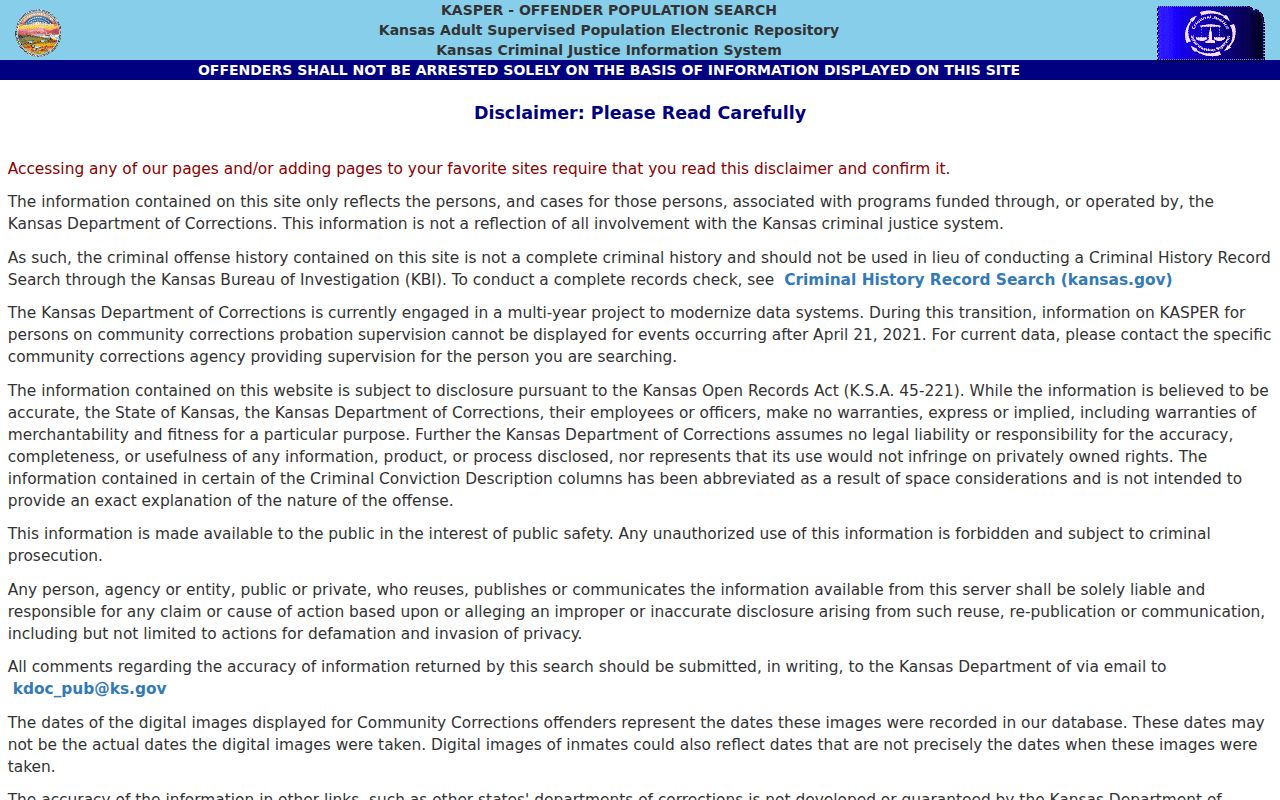
KASPER does not replace a county jail roster, and a recent arrestee may not appear there.
The Kansas Office of Vital Statistics is the source shown below for state vital certificates.
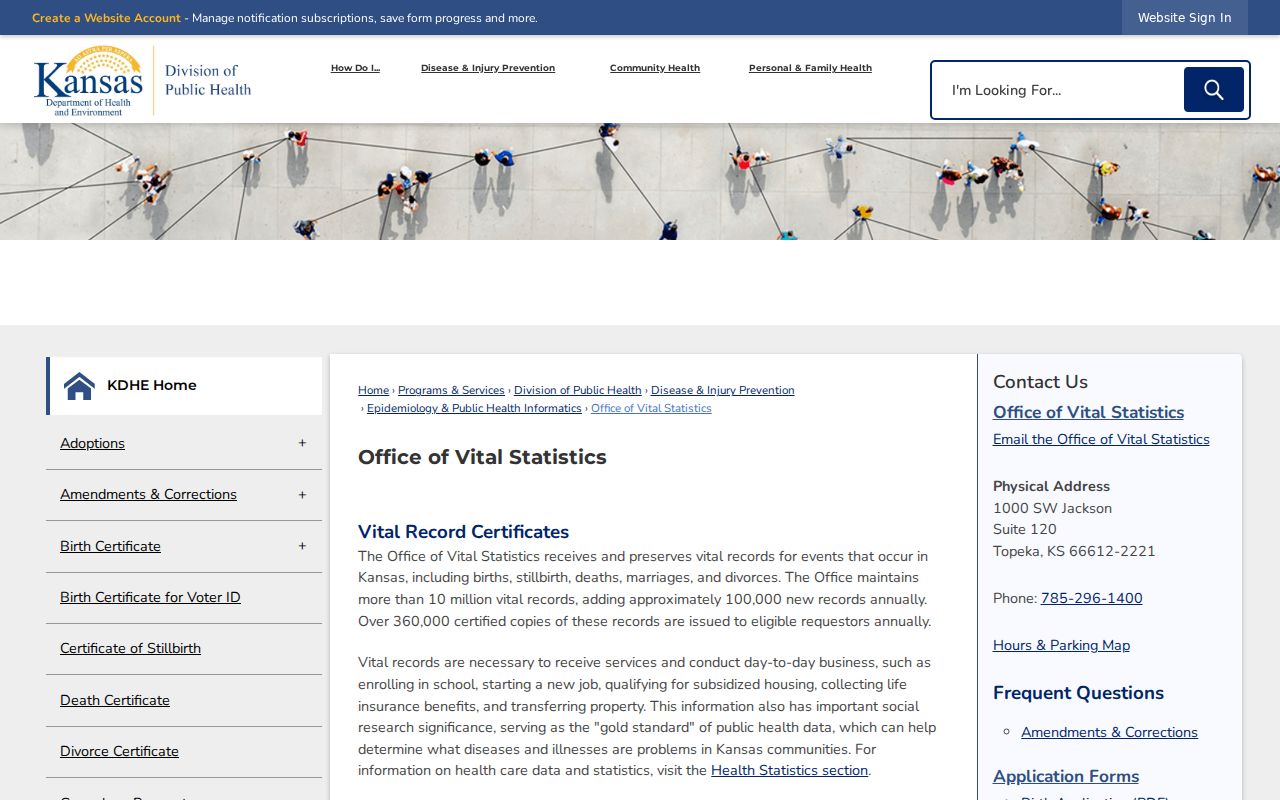
KDHE supplies a certified summary product, while the issuing or filing District Court holds the original marriage record or divorce case.
Kansas Court Records Access Law
Kansas access depends on the record and custodian. The Kansas Open Records Act, commonly called KORA, presumes agency records open unless law permits or requires withholding. Court case records also operate under Kansas Supreme Court rules, case orders, and judicial doctrines. A request should identify an existing document by case number, caption, county, filing date, and title. Ask for inspection, an electronic copy, a plain paper copy, or certification. Staff need not answer research questions or create a new report.
Key Statutes:
K.S.A. 45-218 requires action on a request as soon as possible and by the end of the third business day, though full production can take longer.
K.S.A. 45-221 lists records that an agency may or must withhold, including several personal and investigative categories.
Kansas Supreme Court Rule 22 distinguishes internet access from courthouse access to district and appellate case records.
K.S.A. 60-2617 seals case information while an arrest warrant is sought and remains unexecuted, and controls other criminal and juvenile sealing issues.
The three-business-day rule is a duty to act or respond, not a promise of completed delivery. A custodian may provide the record, deny with a legal basis, seek clarification, request advance payment, or state when retrieval and redaction should finish. Reasonable actual search, review, redaction, computer, and copy costs can apply. If part of a Kansas record is protected, ask for the reasonably separable public portion.
Restricted Kansas Court Records
Not every lawful Kansas court record is public online. Adoption files, many juvenile offender and child-in-need-of-care records, mental-health material, grand-jury proceedings, and expunged cases can be restricted. Social Security numbers, financial account data, protected addresses, full minor identifiers, victim details, and medical information are redacted from otherwise public documents. A courthouse terminal may reveal public material that is not allowed on the internet, but it cannot open a truly sealed file.
Sealing, redaction, and expungement are different. Sealing limits access to a file or document. Redaction removes protected parts from a released copy. Expungement restricts ordinary disclosure of a qualifying record under a statute, while listed officials or authorized users may retain access. Kansas provides separate paths for arrest, conviction or diversion, municipal, and juvenile records. Eligibility, waiting periods, exclusions, filing place, and fees differ. A public no-result can also reflect an unexecuted-warrant seal, not proof that no Kansas matter exists.
Note: Parties seeking a restricted Kansas record should contact the filing clerk with identification and follow the specific court application or order process.
Find Kansas Court Records by County
Every Kansas county has a District Court location and clerk's office, even when several counties share one judicial district. The filing county remains the key to original pleadings, certified copies, archived papers, terminal access, and local court rules. The six high-volume or metro counties below offer a fast route to major Kansas court systems. Municipal cases still require the named city court, and a county sheriff remains the source for local custody records.
Johnson County
Olathe · Kansas's most populous county and the high-volume 10th Judicial District
Sedgwick County
Wichita · The 18th Judicial District and the state's largest-city court and jail network
Shawnee County
Topeka · The 3rd Judicial District and home of Kansas appellate court operations
Wyandotte County
Kansas City · The 29th Judicial District in a consolidated city-county government
Douglas County
Lawrence · The single-county 7th Judicial District and a major university-area docket
Leavenworth County
Leavenworth · County, state, federal, and military custody systems require careful routing
Browse the full directory of all 105 Kansas counties to open the court records site for any county.
Kansas Court Records Fees
Kansas statewide filing totals effective July 1, 2025 come from Administrative Order 2025-FN-085. They are not universal copy prices. Certification, per-page copies, archive retrieval, transcripts, service, publication, postage, card processing, and staff review can add cost. A Kansas clerk should identify whether a quote is a statutory docket fee, surcharge, certification charge, actual KORA production cost, or local service expense. Filing poverty relief also does not promise free certified copies.
| Item | Amount |
|---|---|
| Divorce filing | $195.50 scheduled total |
| Probate of an estate or will | $131.50 scheduled total |
| Marriage license | $85.50 scheduled total |
| Municipal court appeal | $94.50 scheduled total |
| KDHE marriage or divorce certificate | $20 per five-year search and one copy, plus any channel fee |
These dated figures help distinguish filing from record access. For a copy request, give the Kansas clerk the case number, exact document, delivery format, and whether certification is needed, then request an estimate before work exceeds a stated limit.
Read Kansas Court Records Correctly
Read each Kansas event in context. A complaint, information, or indictment states an allegation. It is not a conviction. A disposition is the outcome of a case or count, such as dismissed, acquitted, diverted, or convicted. A journal entry is the written record of a Kansas ruling, judgment, or proceeding. The register of actions, often called an ROA, is the chronological event index. Configuration and legacy labels can vary, so the displayed text controls. Do not invent a universal case-number or abbreviation scheme.
- Pending or open
- The matter continues, although one or more counts may already have an outcome.
- Closed
- The broad case status is closed; later collection, appeal, expungement, or reopening may still occur.
- Dismissed
- A claim or count ended, subject to the order's terms and whether lawful refiling remains possible.
- Diversion
- Prosecution is deferred while conditions are completed; it is not the same as acquittal.
- Certified copy
- The Kansas custodian attests that the copy comes from its official record.
Kansas Court Record Limits
Electronic access is a delivery layer, not the record itself. Kansas eCourt conversion dates determine when a county's document images begin, and some public records remain courthouse-only. The 2023 ransomware incident also forced manual filing and delayed electronic access during recovery. A portal no-result can reflect spelling, municipal venue, old paper files, protected categories, sealing, delayed filing, or the fact that no court case was started. It cannot by itself settle identity, guilt, marital status, custody, or warrant status.
Correct an error at the system that owns it. The filing clerk handles a Kansas court docket or judgment. KBI handles repository submission errors with official proof. KDOC addresses corrections profile or sentence-computation questions. KDOR controls driver data, and KDHE controls its certificate index. Keep the certified source document because another agency may need it before changing a transmitted record.
Note: Confirm any Kansas court date, balance, warrant event, or disposition with the filing clerk before relying on a live portal result.
Kansas Court Records Questions
Are all Kansas court records online?
No. The statewide portal covers District Court case information, but internet documents depend on eCourt conversion and access rules. Municipal dockets use city systems. Some public material is available only at a courthouse terminal or from the filing clerk. Sealed and confidential items remain unavailable through ordinary public channels.
Which clerk keeps a Kansas case?
The clerk of the district court in the filing county keeps state criminal, civil, family, probate, and marriage-license records. The Kansas county clerk is a different local-government office. A municipal clerk keeps original city ordinance cases, and federal clerks keep federal cases.
Does a Kansas name match prove identity?
No. Compare the filing county, case number, party role, year, and other lawful identifiers. Kansas court portals may suppress birth dates, and two people can share a name. A certified record still proves what the court filed, not that every allegation was true.
How can an older Kansas record be found?
Check the filing county and approximate year, then contact that clerk. Ask whether the file is paper, microfilm, archived, transferred, or indexed under a legacy number. Give the parties, case type, document name, and known dates. The courthouse terminal can also expose public material not delivered online.
How fast must a Kansas public office respond?
K.S.A. 45-218 generally requires action by the end of the third business day. That action can be production, denial, clarification, a fee request, or an explanation of delay. It does not guarantee that a large or redaction-heavy file will be delivered in three days.
Where can a certified Kansas court record be ordered?
Order from the custodian that owns the record. For a District Court filing, that is the clerk in the filing county. State agencies certify only their own products, such as a KDHE certificate, KDOR driver record, KBI history, or KDOC profile data.