
Kansas Has No Universal Search
Kansas courts issue warrants, while sheriffs and other law-enforcement agencies act on them and maintain operational information. District judges or magistrate judges handle state cases. Municipal judges handle city ordinance matters. Secure criminal-justice systems can carry statewide or interstate alerts, but no comprehensive public Kansas warrant database offers universal name clearance. Public information is fragmented among district clerks, Municipal Courts, sheriffs, and selective most-wanted lists.
The Kansas District Court Public Access Portal may show events after a warrant becomes public, but it is not a warrant-clearance system. Municipal dockets are separate. An online sheriff row may lag a recall, and an active secure record may have no public page. Use the Kansas county directory to identify the issuing county, then confirm with the named court and law-enforcement agency.
Kansas Warrant Types
The word “warrant” covers several legal tools, and the response depends on the type and issuing authority. A support contempt matter does not automatically mean a warrant exists. Likewise, an out-of-state hold is not something a Kansas local court can erase. Read the exact court, case, and status rather than inferring the warrant type from a short list.
- Arrest warrant: directs law enforcement to arrest a named person based on judicial authority and probable cause.
- Bench warrant: is commonly issued after failure to appear or comply with a court order.
- Search warrant: authorizes a defined search; its affidavit and return follow a different access timeline.
- Probation warrant: concerns an alleged supervision violation and may lead to a revocation proceeding.
- Fugitive or outside hold: reflects another jurisdiction's demand and requires confirmation with that jurisdiction.
A case can contain more than one warrant event. An initial arrest warrant may be followed months later by a failure-to-appear or probation warrant, then by service or recall entries. Always record the event date and status.
Search Kansas Warrant Records
Collect the subject's exact legal name, lawful aliases, birth date for secure verification, issuing county or city, case or warrant number, suspected issue date, and underlying count. Use official contact details reached independently, not a number supplied by an unsolicited caller. Calling law enforcement can result in arrest, while a clerk may limit what it confirms by telephone. Counsel can check the issuing venue and plan a lawful response.
- Identify every likely county and city from the missed hearing, charging paper, citation, probation office, or official notice.
- Check the official sheriff site, application, warrant unit, or current public list for that jurisdiction.
- Ask the issuing District or Municipal Court clerk for public status, bond, and the next setting.
- Search the known district case, recognizing that an unexecuted-warrant case may be sealed.
- Confirm whether each warrant is active, served, recalled, quashed, or outstanding in another case before relying on the result.
No official statewide public warrant hotline was located. A missing online result is not clearance. It may reflect a sealed unexecuted warrant, a city case, a selective list, delayed synchronization, or a jurisdiction without an online roster.
No Kansas Universal Search Fields
There is no honest statewide warrant search-field table to publish because Kansas has no comprehensive public statewide search interface. County and city systems use different controls. Some offer a name box, some publish a fixed list, and some require direct contact. Presenting “last name,” “first name,” or “date of birth” as universal required fields would invent consistency that the official research did not establish.
Practical rule: Use only the controls shown by the official local source, then confirm the apparent match with the issuing court.
Name-based matches are especially risky. Birth dates may be withheld from public displays, and people can share a name. A case number, issuing court, county or city, and issue date provide stronger matching context. Do not publish a home address or tactical law-enforcement information.
What Kansas Warrant Records Show
A public Kansas warrant listing may expose only part of the operational record. The fields below are a documented public-field inventory, not a promise that every sheriff or court publishes each item. Sealed, juvenile, and investigative material is excluded. “Most wanted” pages are selective and should never be read as a complete local roster.
| Field | What It Shows |
|---|---|
| Subject | Name and sometimes age or limited birth-date information used to distinguish an apparent match. |
| Warrant or case number | Identifier needed when calling the clerk or sheriff. |
| Issue date | Date the warrant event was entered, not proof of current status. |
| Issuing court | District or Municipal Court with authority to recall or quash the warrant. |
| Underlying count | Public charge or failure-to-appear basis, which remains an allegation unless adjudicated. |
| Bond and status | Public terms and displayed active, served, recalled, or other label, all subject to current confirmation. |
Record the official source, page or phone route, and exact verification time. A sheriff's removal of a row does not itself prove judicial recall, and a court recall may take time to reach law-enforcement databases.
Why Kansas Warrants May Be Sealed
K.S.A. 60-2617 seals the existence and information of a criminal or juvenile case while an arrest warrant is sought and remains unexecuted. It also seals subpoenas and requires good-cause findings that balance Kansas's strong public-access interest for other sealing or redaction. The rule explains why a live law-enforcement warrant may have no public case result.
The current K.S.A. 60-2617 source is preserved in this official image.
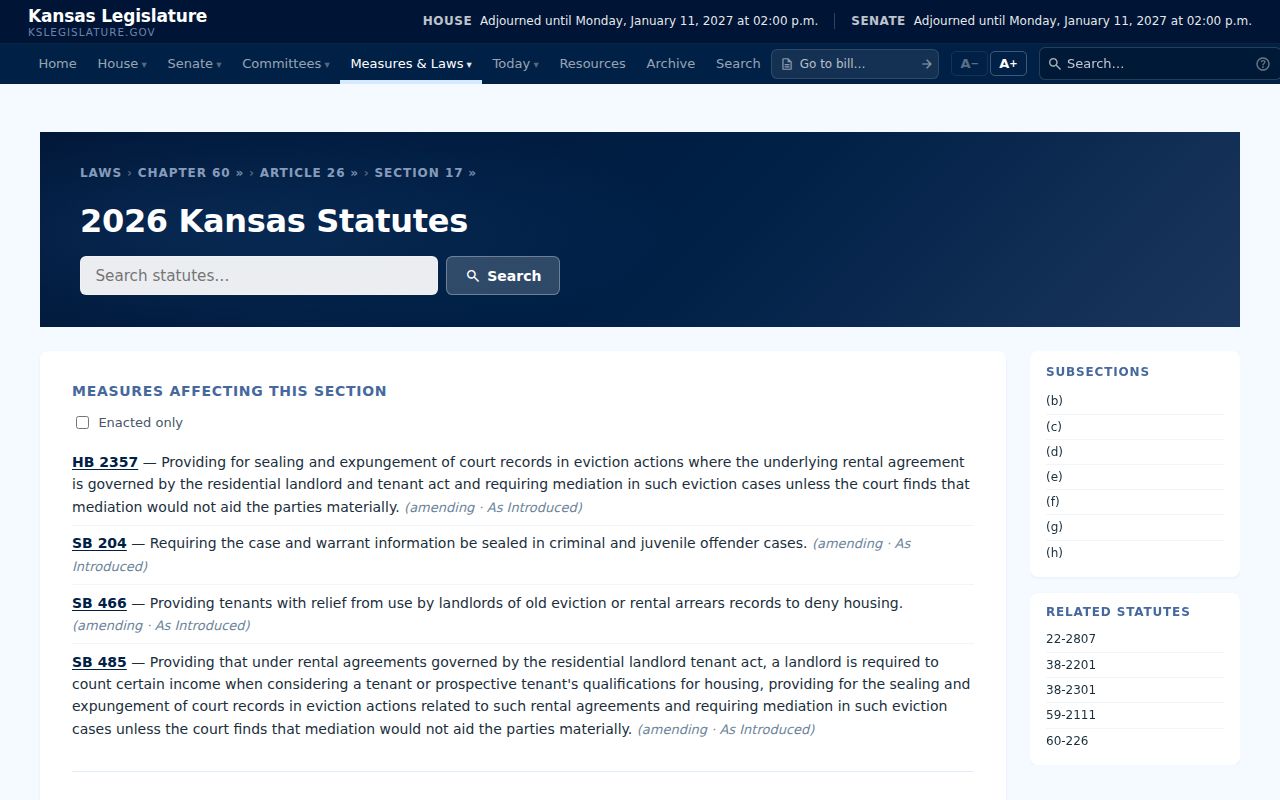
The Kansas statute makes the missing-result warning concrete: public silence during the sealed phase cannot certify that no warrant exists.
Search-warrant materials follow another timeline. Before execution or during an investigation, an affidavit or return may be sealed or withheld. Some material can become a court record later, subject to redaction or order. Absence of a public search-warrant document is not proof that no search authority was issued.
Resolve a Kansas Warrant Safely
Identify the issuing court, case, underlying allegation, missed date if any, public bond terms, and next setting. A licensed Kansas attorney can ask about recall or quash procedures, coordinate surrender, and address a probation or outside-jurisdiction hold. A sheriff does not erase a judicial warrant merely because payment is offered or a web row disappears. The issuing court controls recall or quash, and processing must reach enforcement systems.
Important: Contact Kansas counsel before surrender when possible, since bond, transport, probation, and outside holds can change the safe response.
Displayed bond can change after surrender, a new allegation, or judicial review. Cash-only, surety, personal recognizance, no-bond, and hold labels are not interchangeable. A bondsman's premium is not the same as refundable court bond. After any court action, obtain the written recall, quash, or service order and confirm that the official docket reflects it. Carry a certified copy if counsel or the court advises, and allow time for database synchronization.
Kansas Warrant Scams and Tips
Local or regional Crime Stoppers programs can accept tips about wanted people, but no single statewide warrant search or universal anonymous-tip route was established. Use only the current official program named by the relevant local agency. A “most wanted” post is selective, and its removal does not prove a warrant was recalled. Never confront a listed person or publish protected location data.
Warrant scams often spoof a sheriff or court number and claim missed jury duty. Kansas courts may collect lawful fines through approved channels, but a demand for secrecy, gift cards, cryptocurrency, or an immediate kiosk deposit to avoid arrest is a warning sign. End the call. Navigate independently to an official judiciary, city, or county source and verify the case number with the issuing office.
Request Kansas Warrant Records
Kansas Open Records Act access can reach existing public agency material, but it does not override sealed cases, juvenile limits, court orders, investigative exemptions, or protected personal data. K.S.A. 45-218 requires the agency to act as soon as possible and by the end of the third business day. That does not guarantee full production within three days. A response may produce the record, deny with a legal basis, seek clarification or payment, or give a production estimate.
The current K.S.A. 45-218 inspection and response law appears in this official-source image.
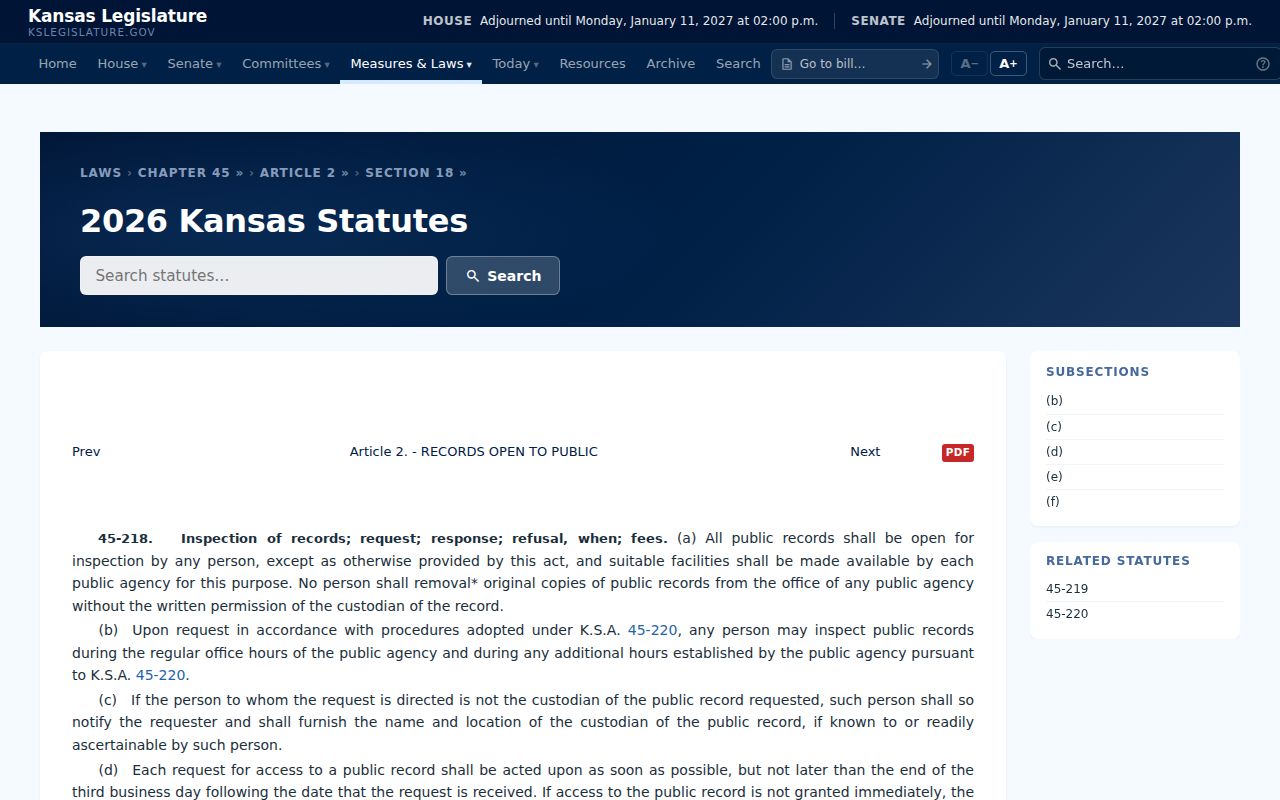
The image supports a focused request process rather than a promise of instant warrant production.
K.S.A. 45-221 exemptions are shown in the final Kansas warrant source image.
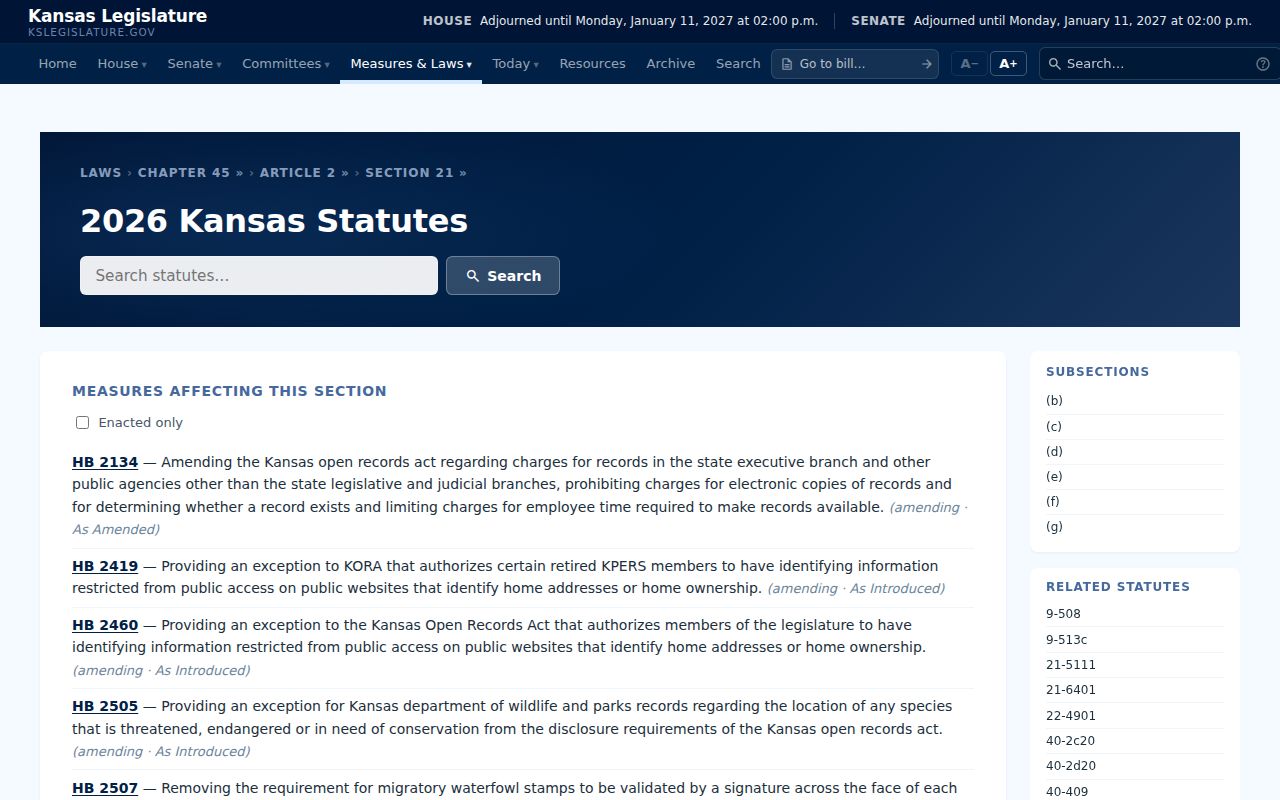
Those exemptions explain why an agency can release segregable public warrant fields while withholding protected investigative or personal details.
A narrow request should name the subject, issuing court, case or warrant number, date, and exact existing document. Ask for segregable public parts and a written basis for any withholding. Federal warrants use federal courts and agencies, not Kansas county records. Juvenile, sealed, expunged, and unexecuted-warrant material may remain unavailable even at a courthouse terminal.
Finish the check with the issuing county or city. For failure to appear, ask about the missed date and new setting. For probation, identify the supervision allegation and revocation hearing. For an out-of-state hold, contact the demanding jurisdiction. For suspected identity theft, seek counsel and the agency's identity process rather than surrendering on a name-only match.
Note: Kansas warrant status is time-sensitive; record the source and verification time, then confirm again immediately before payment, appearance, or surrender.