
Kansas Records by Office
Kansas uses the clerk of the district court, not the county clerk, for both the marriage-license file and the divorce case. The issuing county's district clerk keeps the marriage application, license, return, and recording information. The filing county's district clerk keeps the divorce petition, docket, orders, and decree. The Kansas Department of Health and Environment Office of Vital Statistics, or KDHE OVS, keeps restricted statewide certificate records for covered dates.
Choose the product first: Get the original marriage license or return from the issuing county's Clerk of the District Court, the divorce decree and case file from the filing county's Clerk of the District Court, and a statewide certified certificate from KDHE OVS.
| Record Needed | Official Custodian | What It Provides |
|---|---|---|
| Marriage application, license, or return | Clerk of the district court in issuing county | Original county court record and available certified copies |
| Certified marriage certificate | KDHE Office of Vital Statistics | Restricted statewide certificate for covered dates |
| Divorce petition, orders, or decree | Clerk of the district court in filing county | Full court case and operative decree |
| Certified divorce certificate | KDHE Office of Vital Statistics | Restricted summary of the vital event |
Apply for a Kansas Marriage License
The Kansas Judicial Branch marriage resource provides the official application path. Applicants select a county district court, supply required personal and prior-name information, and follow that clerk's payment and appearance instructions. The general age is 18. Applicants who are 16 or 17 must meet statutory consent and related conditions. Kansas does not require a blood test.
A three-day waiting period applies, subject to lawful waiver. Applicants should ask how weekends and holidays affect pickup. The license fee is separate from ceremony costs and from any later certified-copy fee. A person authorized under Kansas law completes the ceremony or religious declaration, and the completed record returns to the issuing district court before certificate data reaches KDHE.
Note: The district court may have the completed return before KDHE can locate the new Kansas certificate in its statewide file.
Kansas Marriage License Steps
Use the current judicial instructions and the chosen clerk's directions. Do not assume that a certificate order starts a new license or that the county clerk handles the application.
- Choose the Kansas county district court and complete the official application with both parties' legal and prior names.
- Provide birth, contact, address, protected identifier, and prior-marriage or relationship information required by the form.
- Meet the clerk's identity, age, appearance, and payment rules, then wait the required period unless a lawful waiver applies.
- Have an authorized officiant or permitted religious declaration complete the ceremony record.
- Return the completed license to the issuing district court and confirm recording before ordering a state certificate.
Kansas Marriage Form Fields
The license application gathers data needed to establish identity and record the event. The separate KDHE certified marriage-certificate form shows the requester, relationship, identity, event, county, and prior-name fields used for a state certificate request. Protected identifiers should not be copied into a public search request. Prior surnames matter because later certificate and historical searches may index either name.
| Field | Required | Notes |
|---|---|---|
| Legal and prior names | Yes | Use the names supported by the current application |
| Date of birth | Yes | Used for identity and age eligibility |
| Contact and address | Yes | Follow the form's privacy and delivery instructions |
| Protected identifiers | As required | Do not place them in a general public-record request |
| Prior marriage or relationship data | As applicable | Supply prior names and requested status facts |
| County and ceremony data | Process-specific | Completed through issuance, ceremony, return, and recording |
Kansas Marriage and Divorce Fees
Statewide scheduled court totals took effect July 1, 2025. Service, copy, certification, delivery, and vendor charges can add cost. KDHE's $20 certificate charge is a five-year search fee that includes one copy if found and is retained if no record is located. A broad uncertain date range can therefore require more than one search fee.
| Item | Amount | Where Paid |
|---|---|---|
| Marriage license | $85.50 scheduled total | Issuing clerk of the district court |
| Divorce filing | $195.50 scheduled total | Filing clerk of the district court |
| KDHE marriage or divorce certificate | $20 per five-year search and one copy if found | KDHE OVS |
| VitalChek / phone channel | $20 plus $15 | State-linked vendor channel |
| iKan channel | $20 plus $5 | iKan will-call service |
| Certified decree, license, or return | Clerk quote | Correct county district court |
Order Kansas Marriage Certificates
The KDHE marriage certificate page covers state-filed certificates from May 1, 1913, to the present.
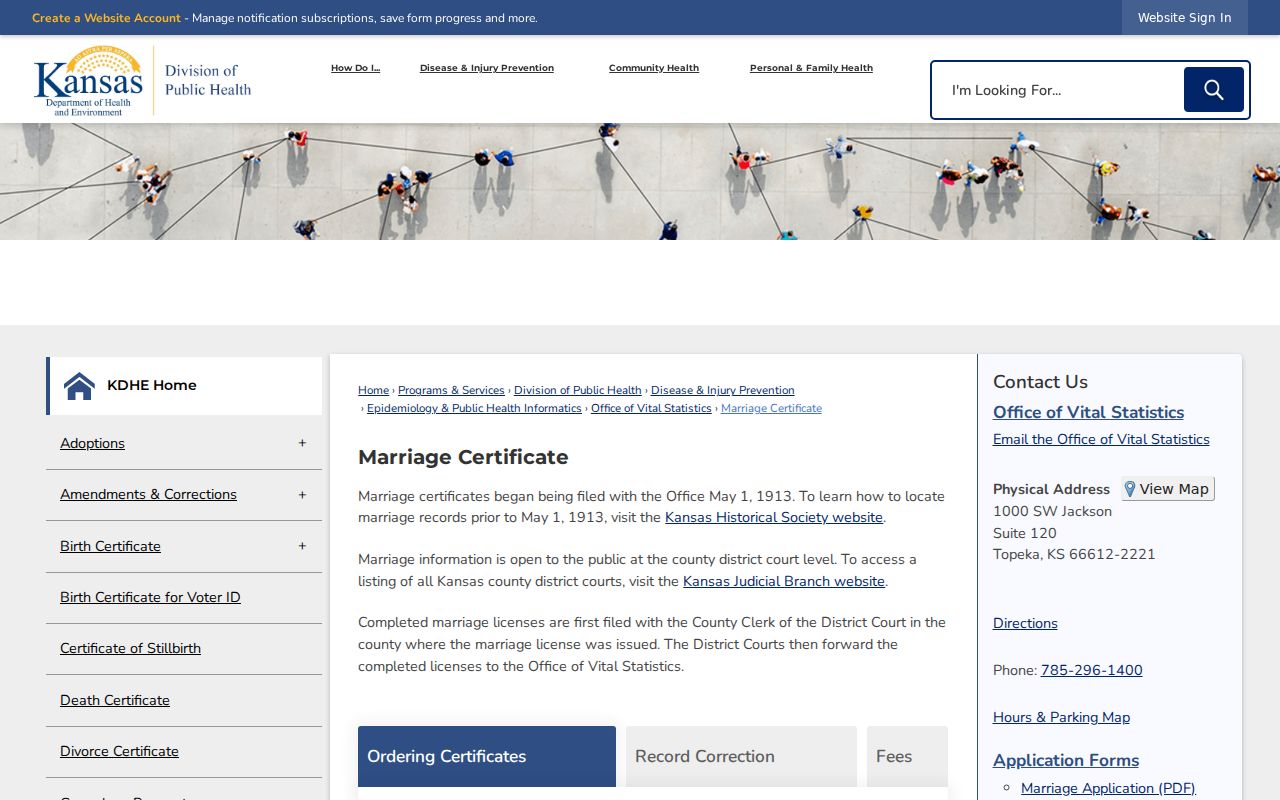
The state page explains the certificate channels, search fee, processing estimates, and the difference between the KDHE product and the district-court record.
The paper request asks for requester name, address, reason, email, signature, telephone, relationship, both parties' full and prior names, dates of birth, event date, and Kansas county and city. It also asks for copies and total payment. A government photo ID or two listed alternatives and proof of direct interest may be needed. Submit exact dates and prior surnames to reduce failed searches.
Pre-1913 marriage records route to the issuing district court or historical holdings. Kansas also recognizes common-law marriage when its legal elements are proved. A no-result in the license index cannot establish that a person was never married.
Find Kansas Divorce Records
A divorce certificate is a short vital record. The district-court decree is the operative order for name change, property, retirement, custody, support, or later enforcement. The filing clerk keeps the petition, service or waiver, domestic-relations affidavit, parenting plan, temporary orders, agreements, decree, and post-decree motions as applicable. The Kansas Judicial Branch divorce resource supplies current forms and procedural information. Financial accounts, protected addresses, child identifiers, and sealed exhibits may be withheld even when the docket or decree is public.
The KDHE divorce certificate page covers state-filed certificates from July 1, 1951, to the present.
The KDHE certified divorce-certificate form identifies the required requester, relationship, identity, party, date, and county information.
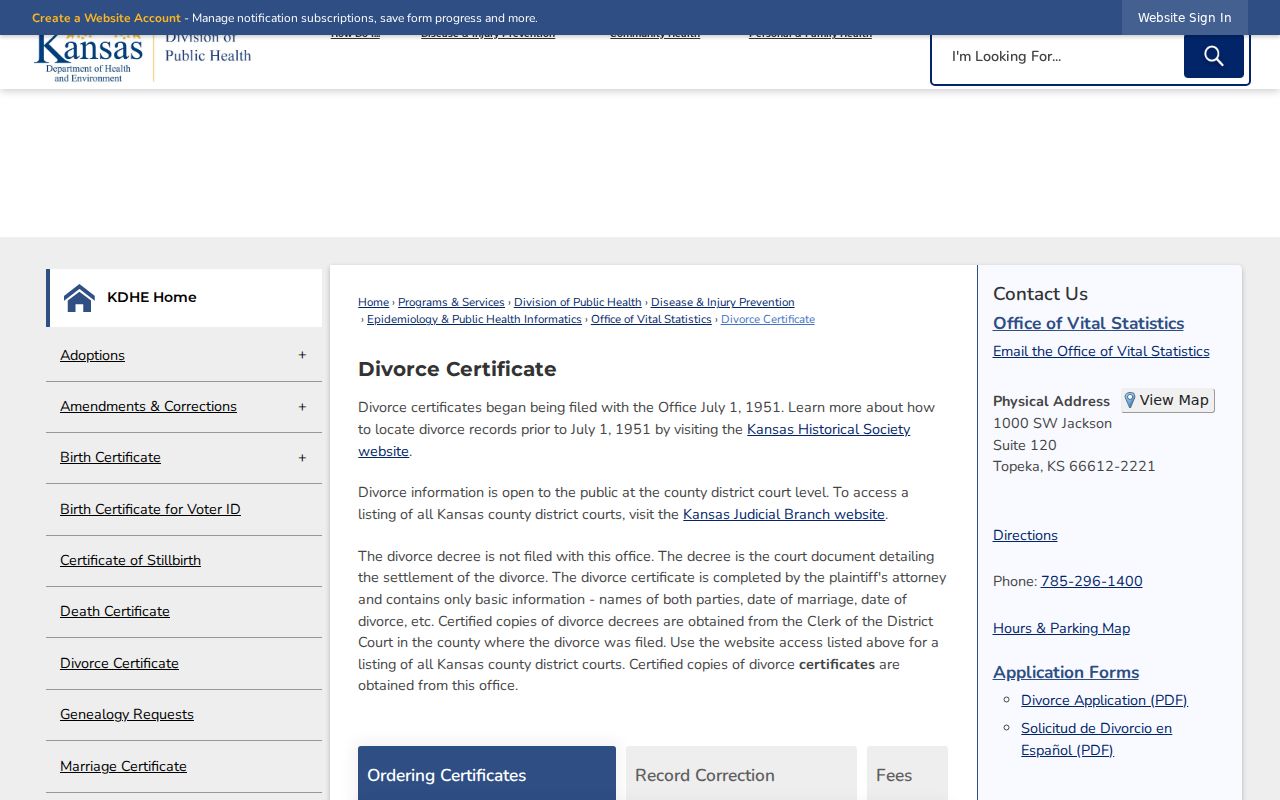
KDHE's official ordering information helps a requester choose the state certificate when the full court decree is not required.
One spouse must have been a Kansas resident for 60 days before filing. Incompatibility is a no-fault ground, and other statutory grounds exist. Service and required financial or family forms still matter in an uncontested case. A final decree generally waits 60 days after filing unless a lawful emergency exception applies.
Note: The divorce filing county follows Kansas venue and residency rules and is not necessarily the county that issued the marriage license.
Choose Kansas Certified Records
Ask the receiving office whether it wants a KDHE certificate, the court's certified license and return, or a certified divorce decree. Certification only attests that the copy comes from that custodian. An apostille or authentication is a separate process. For a recent marriage, confirm that the issuing clerk has recorded and forwarded the return before paying repeated KDHE searches.
- Identify the exact record and ask the recipient what form and certification it accepts.
- Gather both parties' full and prior names, event date, county, and proof of eligibility or direct interest.
- Use KDHE for a covered statewide certificate or the correct Clerk of the District Court for the original court record.
- Submit current ID, form, and fee through the chosen official channel.
- Check the names and dates on receipt. Use the proper amendment route if a certificate conflicts with the decree.
Kansas Vital Records Office
The KDHE Office of Vital Statistics issues restricted certified marriage and divorce certificates. Eligible requesters include the person named, immediate family, a legal representative, or a person who proves direct interest needed to determine personal or property rights. General genealogical interest does not establish access to a recent restricted certificate.
Available channels include Topeka walk-in service, mail, the state-linked VitalChek or telephone route, and iKan will-call. Research records walk-in service from 9 a.m. to 4 p.m. with an estimate of 15 to 20 minutes, mail at 7 to 10 business days, and vendor service at 3 to 5 days after receipt. Processing estimates begin as KDHE describes, not necessarily when an online button is clicked.
KDHE Office of Vital Statistics
Marriage certificates: May 1, 1913 to present
Divorce certificates: July 1, 1951 to present
785-296-1400
Note: VitalChek is the state-linked vendor; do not substitute an unrelated certificate-ordering site with a similar name.
Find Kansas District Court Records
Choose the issuing county for a marriage license or return. Choose the filing county for a divorce case or decree, which may not be the marriage county. The Kansas county directory reaches the clerk of the district court in all 105 counties. Give the clerk full and prior names, an approximate event date, the county, and the exact document requested. Older records may be on microfilm or in an archive.
Note: Ask the receiving entity whether it needs a certificate, decree, license return, apostille, or another specific certified Kansas record.