
Kansas Arrest Records and Charges
Kansas arrest records document the arrest itself: the person identified, arresting agency, arrest or booking date, intake allegation, custody status, and public bond or hold information when released. The arresting agency and county sheriff keep those records. They do not prove guilt. A county or district attorney screens state allegations, while a city attorney screens ordinance cases. Filed counts begin the court record and may differ from what appeared at booking.
The prosecutor's complaint or information, or a grand jury indictment, states the formal court charges after arrest. The clerk of the district court keeps those filings and later docket events. The full Kansas criminal case file supplies pleas, motions, judgment, and sentence; a sheriff's roster supplies custody data. An arrest may yield no filed case, and a summons or citation can start a case without a jail booking. Neither route should be described as a statewide mugshot search.
Find Kansas Arrest Records
Start with the county that arrested or holds the person. An official sheriff roster or records unit can confirm the booking number, custody status, intake charge, bond, release, or transfer. Kansas has no comprehensive statewide public booking database. KASPER covers people sentenced to Kansas Department of Corrections custody, not county jail intake. VINE is a custody-notification system, not a certified arrest history.
- Use the Kansas county directory to reach the sheriff and clerk in the arrest or prosecution county.
- Record the booking allegation, arrest date, agency, and booking number from the sheriff's official source.
- Search the Kansas District Court Public Access Portal by exact case number or defendant name.
- Compare the operative charging document with each current count, amendment, plea, and disposition.
- For an ordinance matter, contact the named Municipal Court because city dockets are not merged into the district portal.
A no-result can reflect a reporting delay, spelling variation, city venue, sealed warrant case, expungement, or a decision not to file. Ask the clerk whether a district record is preconversion, terminal-only, archived, restricted, or absent. Ask the sheriff for an existing booking sheet or release record. Each custodian corrects its own data; a clerk cannot alter the sheriff's roster, and a sheriff cannot amend a filed court count.
Kansas Charging Documents
The operative charging paper matters more than the first jail label. A complaint can initiate criminal allegations and may be supported by sworn facts. An information is the prosecutor's formal accusation without a grand-jury indictment. An indictment is the grand jury's accusation that probable cause exists. None is a conviction. Amendments can later replace or narrow counts, so request the current instrument and review the docket for superseded versions.
| Complaint | Information | Indictment | |
|---|---|---|---|
| Source | Sworn allegations used to begin process | Prosecutor | Grand jury |
| Function | States initiating criminal allegations | States formal counts without grand-jury action | States counts found on probable cause |
| What it proves | An accusation was made | A prosecutor filed an accusation | A grand jury returned an accusation |
| Next check | Read amendments and the count-level judgment before stating an outcome. | ||
Read Kansas Charge Status
Each count needs its own timeline. “Pending” means unresolved. “Amended” means the allegation or severity changed, so compare the original and current count. “Dismissed” ends that count subject to any with-prejudice or without-prejudice language. “Acquitted” means a not-guilty result. Diversion conditionally pauses prosecution and can lead to dismissal after completion, but it is not an acquittal. A case marked closed can still contain mixed outcomes or later postjudgment activity.
| Status | What It Means |
|---|---|
| Pending | No final result yet; later settings or motions may be scheduled. |
| Amended | The prosecutor changed the count, statute, description, or severity. |
| Dismissed | The count ended, but the order controls whether and how it may be refiled. |
| Acquitted | The defendant was found not guilty on that count. |
| Convicted | Judgment followed a guilty or no-contest plea or guilty verdict. |
Kansas Charges Versus Convictions
An arrest allegation and a filed charge both precede judgment. Neither establishes guilt. Probable cause supports arrest and early criminal process, while conviction at trial requires proof beyond a reasonable doubt. A guilty or no-contest plea can also lead to conviction. The strongest outcome proof is the signed journal entry of judgment and sentence, a filed dismissal, or an acquittal record for the exact count.
| Charge | Conviction | |
|---|---|---|
| Stage | Accusation | Verdict or plea |
| Burden of Proof | Probable cause | Beyond reasonable doubt |
| Source | Current charging instrument | Signed judgment or sentencing journal entry |
| Possible later change | Amended, dismissed, diverted, tried | Appealed, corrected, revoked, or expunged |
Kansas Sealed and Expunged Records
Sealing restricts access under a statute, rule, or order. Expungement applies Kansas statutory limits to qualifying records but does not mean every copy is destroyed or that no authorized recipient can obtain it. K.S.A. 22-2410 governs arrest-record expungement, while K.S.A. 21-6614 covers qualifying convictions and diversions. Different routes also apply to municipal and juvenile matters. Waiting time and eligibility must be checked under current law.
- Sealed record
- Withheld from ordinary public view, with access controlled by the sealing authority.
- Expunged record
- Subject to statutory nondisclosure and limited later access; it is not a universal physical erasure.
An accurate event may need expungement; a data error needs correction. Obtain the court's certified dismissal or judgment, identify the exact KBI or sheriff entry, and use that custodian's challenge process. Kansas automatic relief effective in described all-charges-dismissed or acquitted cases after July 1, 2025 has timing, objection, appeal, and exception rules. It does not clear every older arrest automatically.
Kansas Charge Codes and Severity
A Kansas filed count should show the statute or ordinance, offense description and date, felony severity or person designation, or misdemeanor class when applicable. State criminal cases belong in District Court. City ordinance charges belong in Municipal Court even when their labels resemble state offenses. One arrest can produce several counts at different levels, and the prosecutor may amend them as evidence and legal decisions develop.
Kansas felony grids resist simple “degree” translations. Nondrug levels generally run from 1 through 10, with level 1 most severe, while drug offenses use their own current grid structure. A severity level does not predict the sentence by itself. Criminal history, presumptions, departures, special rules, probation, and the signed order all matter. Misdemeanor classes and unclassified offenses likewise require the actual statute and judgment.
KBI Kansas Arrest History
The KBI Kansas Criminal History Record Search compiles reportable Kansas arrest and disposition submissions linked to identity. It is not every pleading, police narrative, out-of-state event, or federal record. Public dissemination depends on requester authority. Juvenile, sealed, expunged, and nonconviction data is not universally disclosed. A name-based result can be a possible match, while fingerprints are the more reliable identity method.
An official KBI history can group an event by arresting agency, arrest date and identifier, arrest allegation, court charge, case number, disposition date, sentence, and corrections information. Read the event through its final submitted outcome. A booking allegation can differ from the prosecutor's filed count, and the conviction offense can differ again after amendment or plea. When a KBI entry conflicts with the court, obtain a certified dismissal or journal entry and use the repository's correction process. The filing court corrects its own docket; KBI addresses the central submission. A telephone request cannot rewrite a valid Kansas judgment.
KBI also operates a registered-offender registry, but that is offense-registration specific. The official Kansas Registered Offender Search gateway is shown in the first source image.
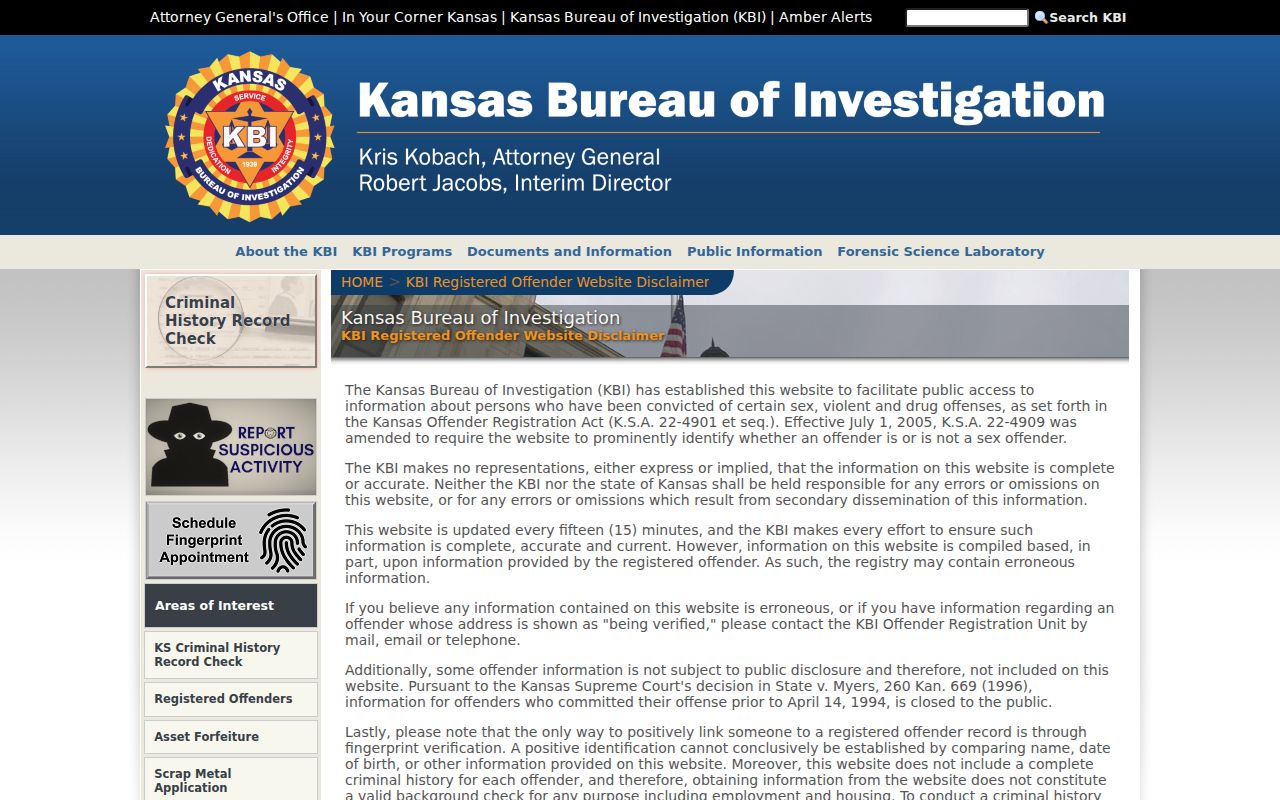
Registry presence or absence is not a substitute for Kansas arrest records, court charges, or a KBI criminal-history check.
The exact KBI registered-offender interface appears in the next official source image.
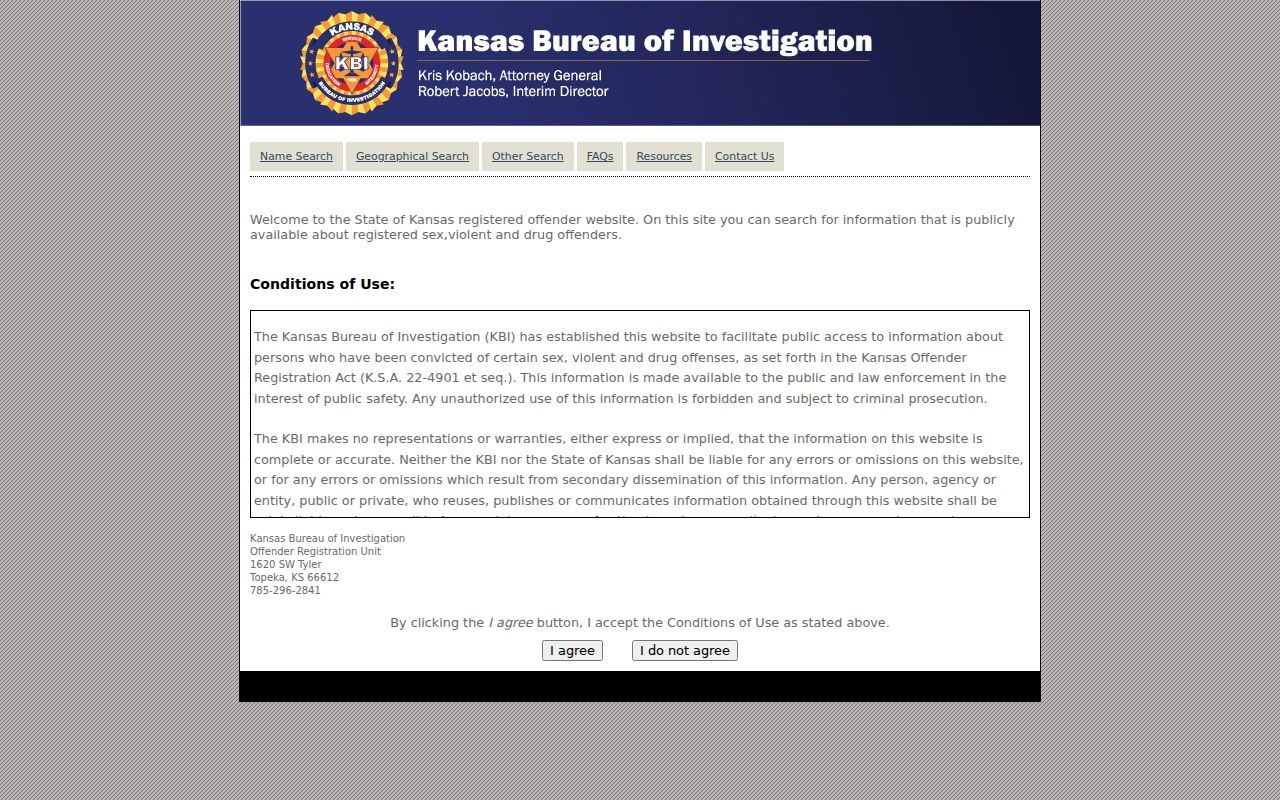
Its focused purpose and public-use cautions reinforce why registry results must not be recast as a general arrest database.
Kansas Agency Record Boundaries
The clerk, sheriff, prosecutor, and KBI hold different records. A narrow Kansas Open Records Act request to a sheriff may seek a booking sheet, release record, or public bond data. An incident report, video, witness material, victim details, or active investigation can be withheld or redacted under K.S.A. 45-221 and other authority. A prosecutor's work product and strategy are not the same as filed court documents. Ask for segregable public portions and a written legal basis for withheld material.
Important: Public access alone does not authorize use of Kansas arrest data for employment, housing, credit, licensing, or other regulated decisions.
Federal prosecutions use a separate court and agency path. The U.S. Attorney's Office for the District of Kansas is represented in the final source image.
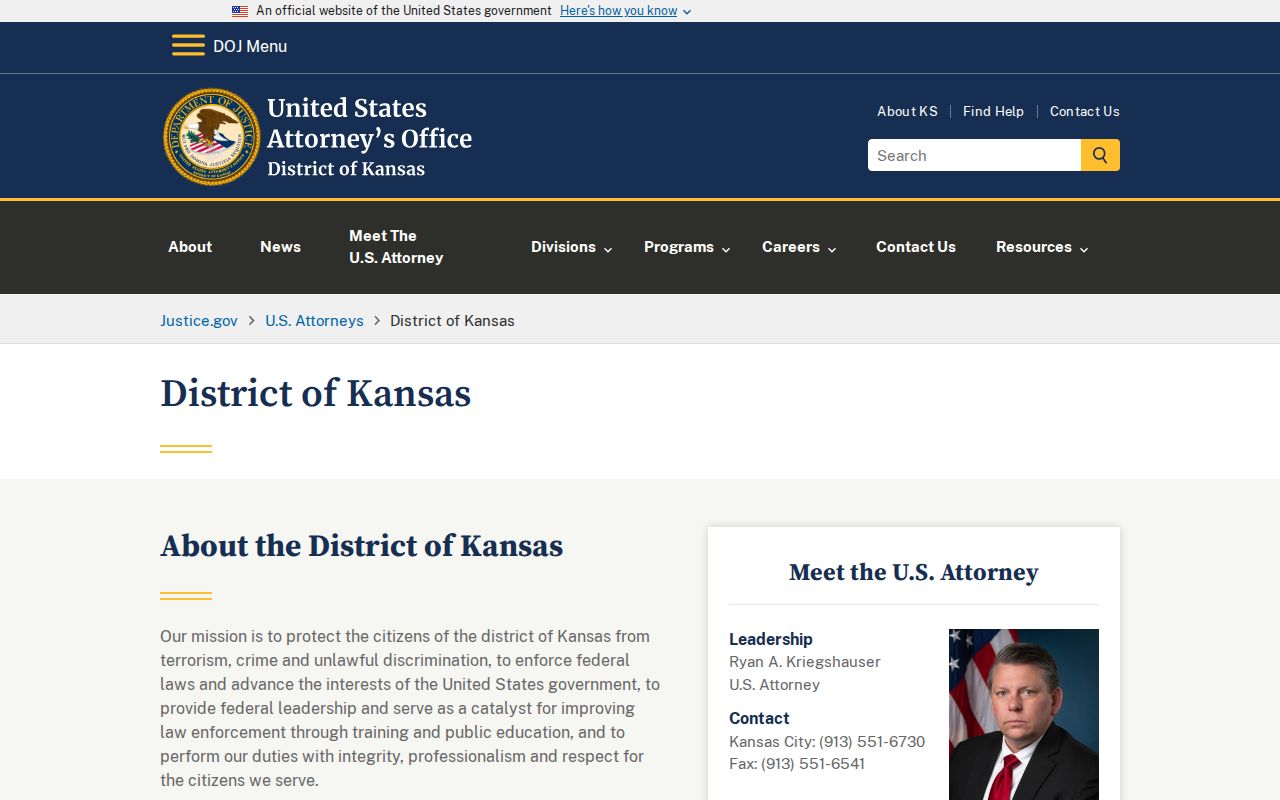
A federal arrest or indictment belongs in the U.S. District Court record and federal systems, not the Kansas district case portal. The U.S. Marshals Service District of Kansas handles federal warrants, prisoner movement, and court security, but its secure operational warrant system is not a public statewide lookup.
Restricted Kansas Arrest Records
Juvenile and child-in-need-of-care matters, grand-jury records, protected victim or witness data, medical information, full identifiers, sealed files, expunged events, and active investigative material can be missing or redacted. Kansas law also seals the existence and information of a criminal or juvenile case while an arrest warrant is sought and remains unexecuted. A public no-result therefore cannot certify that no arrest, warrant, or restricted case exists.
For a final county check, use the place of arrest for booking records and the place of prosecution for court charges. Provide the legal name, known aliases, birth date through a secure official route, arrest date, agency, booking or case number, and exact document sought. Ask the clerk for the operative charging instrument and signed disposition. Ask the sheriff for custody dates. If a Municipal Court handled the case, contact that city directly because Kansas district and municipal systems remain separate.
Note: Arrest date, booking date, filing date, disposition date, and sentence date describe different events and should never be collapsed into one record date.