
Route Kansas Traffic Court Records
Read the court and response date printed on the citation. A city ordinance ticket belongs with that city's municipal court and may be absent from the statewide district portal. A state-law citation naming a district court belongs with the clerk of the district court in that county. Parking can follow an administrative city process. The officer's uniform does not settle venue: even a Highway Patrol ticket may direct a driver to a county district court.
The Kansas Judicial Branch district-court explanation describes the statewide trial-court structure behind state citations.
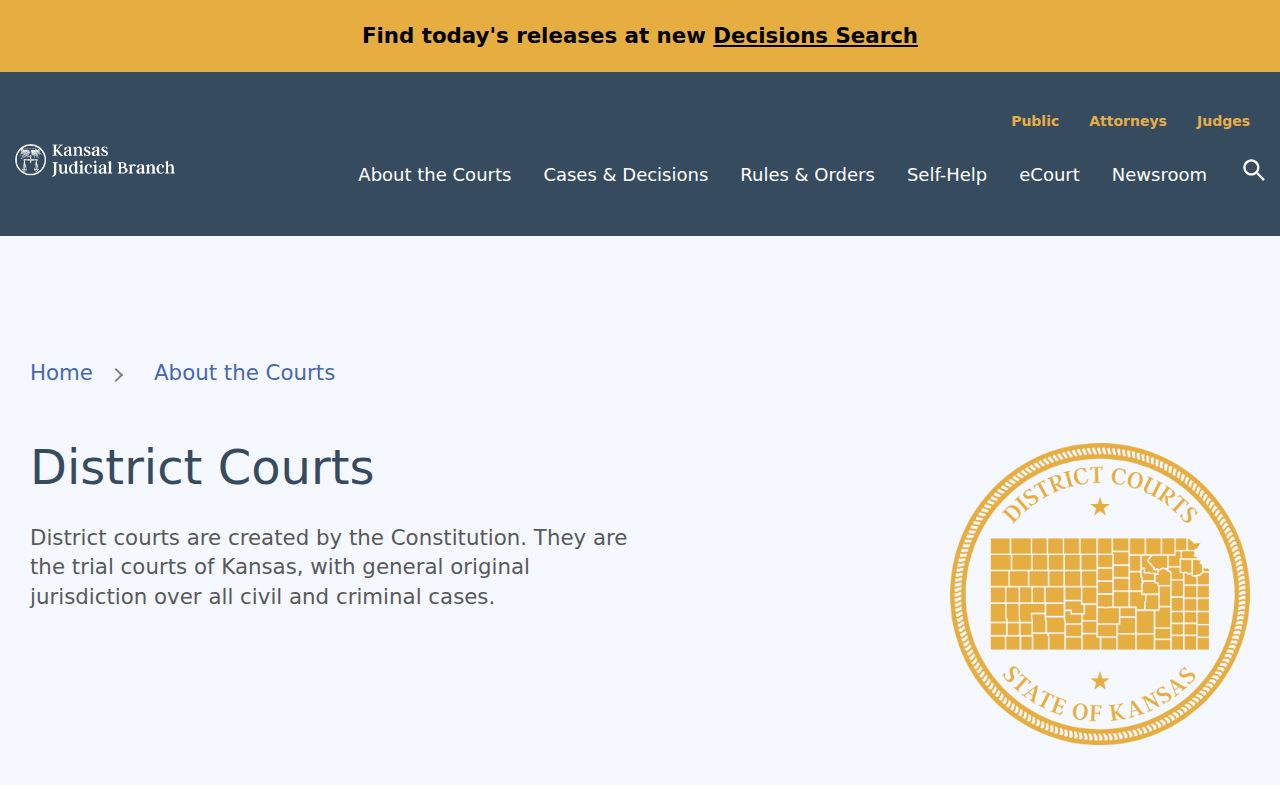
District courts handle state-law matters across Kansas, while municipal courts remain locally operated city courts for ordinance cases.
Routing rule: Use the printed court, not the arresting or ticketing agency, to choose the official Kansas traffic case system.
Search Kansas Traffic Citations
No universal municipal citation portal covers Kansas. For a district case, the Kansas District Court Public Access Portal may supply statewide district case information, subject to electronic access limits. For a city ticket, use the named municipal court's system or clerk. If the ticket is new or no Pay control appears, call the court. Absence can mean delayed entry, mandatory appearance, late status, warrant, a nonpayable charge, or simply the wrong court.
| Search Field | Type | Required | Notes |
|---|---|---|---|
| Citation or case number | Text | Alternative | Copy the printed format and leading zeros |
| Last / first name | Text | Name path | Use the exact spelling on the citation |
| Date of birth | Date | Portal-specific | Helps distinguish common names |
| Driver license number | Text | Portal-specific | Use only on the official court or agency form |
| Search / Pay | Control | Action-specific | Payment may be available only for eligible cases |
Citation-number searches are safer than name-only matches. Record the violation date and court because filing, hearing, disposition, and driver-report dates are different. A search result is a locator. Request the court's journal entry or disposition when proof is needed.
Read Kansas Traffic Court Records
A Kansas traffic case file tracks what was charged and what the court did. It can show a later prosecutor amendment, plea, hearing, failure to appear, warrant, disposition, fine, costs, and payment. A charge is an allegation until the court enters a result. Payment may carry a plea, so read the court's instructions before using a payment button.
| Field | What It Shows |
|---|---|
| Citation and case number | Ticket identifier and court case identifier |
| Violation and filing dates | Alleged conduct date and court entry date |
| Offense | Ordinance or statute cited, including later amendment if shown |
| Plea and hearing | Response entered and scheduled court event |
| Disposition | Conviction, dismissal, diversion, or other recorded outcome |
| Fine, costs, payment | Ordered sums and current posted ledger information |
| Warrant or FTA | Court entry concerning failure to appear when public |
Crash reports form a third record type. An investigating agency's crash report may include an exchange sheet, diagram, narrative, and a citation under applicable access rules, but it is not the court docket or a KDOR driving record.
Kansas Court and Driver Records
The court file and the Kansas Department of Revenue Division of Vehicles file serve different functions. A court keeps the legal case in the issuing venue. KDOR maintains license status and reportable convictions or administrative actions. A court reports a disposition to KDOR, and processing can create a lag. Check both sources when a result affects driving privilege.
| Issue | Court Traffic File | KDOR Driver Record |
|---|---|---|
| Source | Municipal clerk for an ordinance; Clerk of the District Court for a state ticket | KDOR Division of Vehicles |
| Shows | Charge, plea, hearing, disposition, fine, warrant | Status, restrictions, reportable convictions and actions |
| Access | City system or district portal, terminal, or clerk | Free status check or paid official record |
| Correction | Issuing court corrects its case record | KDOR addresses its license or history record |
One record does not automatically correct the other. Obtain the court disposition, then ask KDOR what report or compliance item remains if the license file has not changed.
Note: A court result and a KDOR status answer different questions, so preserve the source and the date of each check.
Check Kansas Driver Records
The KDOR driver's-license status form provides a free Kansas summary.
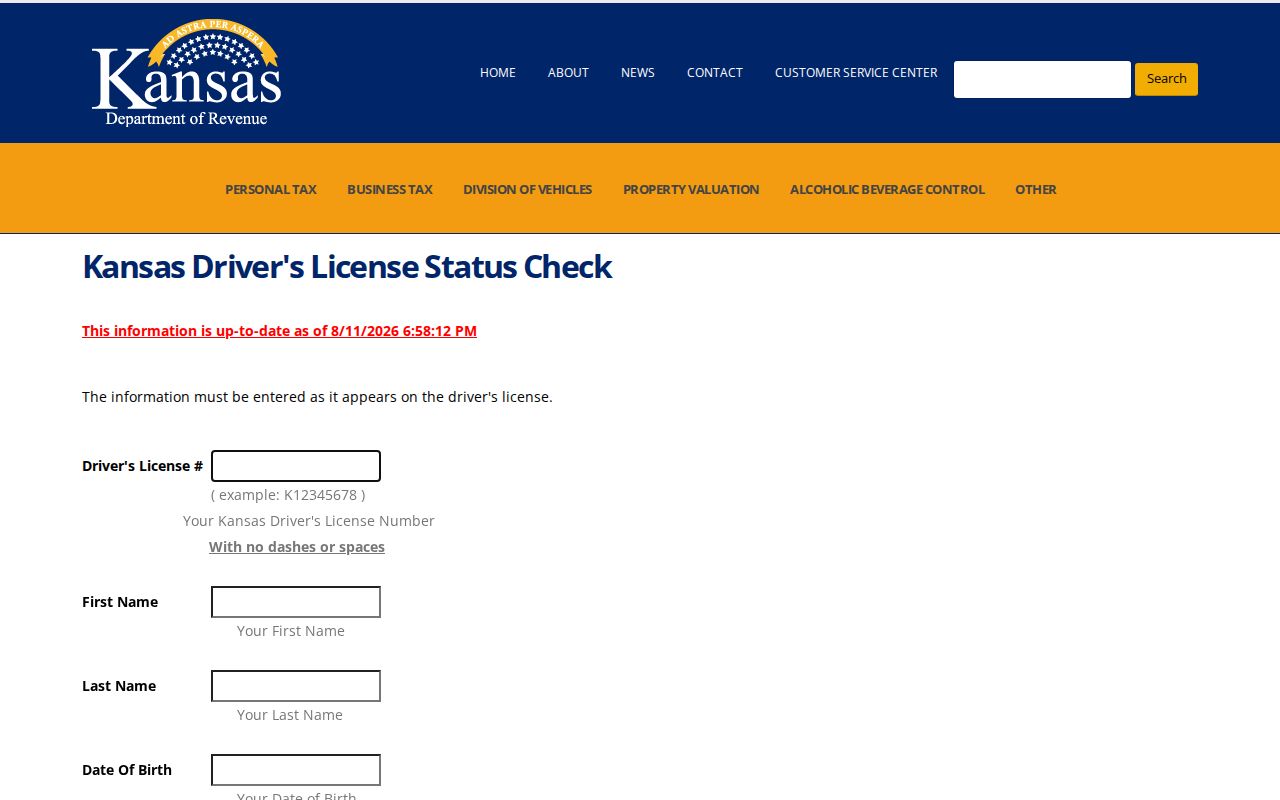
The form requires the driver's license number without dashes or spaces, first name, last name, and birth date. It links separately to the paid record service.
The free result is not a full driving history or proof that driving is lawful. KDOR warns that sanctions from another state are absent, and completing listed items does not assure validity. A full record can include class and status, dates, restrictions or endorsements, reportable convictions, included accidents or actions, and suspension or reinstatement entries. The KDOR records instructions explain request options and authorization.
- Driver's License Number
- Required Kansas identifier, entered without dashes or spaces.
- First and Last Name
- Required exactly as held on the license record.
- Date of Birth
- Required in month, day, and year format.
- Buy Record
- Separate paid path for an official motor vehicle record.
Access to another person's driver information requires a lawful purpose or authorization under the federal Driver's Privacy Protection Act and Kansas rules. A request may require requester identity, subject data, product or certification choice, purpose, signature, authorization, and payment. Driver Solutions lists 785-296-3671 and fax 785-296-6851.
Resolve Kansas Traffic Tickets
A response should follow the court and deadline printed on the citation. Payment can amount to a guilty or no-contest plea and may produce a reportable conviction. Contesting requires a timely plea or hearing request. Discovery, continuance, officer subpoena, diversion, amendment, and remote appearance follow local court and prosecutor procedure. Court staff can explain filing steps but cannot predict insurance or licensing results.
- Verify the official court, citation number, offense, and response or appearance date on the ticket.
- Ask whether the charge is payable or requires an appearance. Read the plea effect before paying.
- To contest, submit the required not-guilty or hearing request before the stated deadline and keep proof.
- Ask the local court about lawful diversion, a course, payment plan, or ability-to-pay process before default.
- After disposition, confirm the court ledger and separately check KDOR status when driving privilege is involved.
A portal convenience charge is separate from the fine and costs. Save the confirmation, then verify posting. Never send money to a caller. Use the court's official website or number and match the citation or case identifier.
Note: A missing online payment option does not mean a Kansas citation was dismissed or that no response is due.
Kansas Traffic Record Categories
Moving violations, equipment matters, parking, commercial-driver cases, DUI, and camera claims do not all follow the same path. Parking may remain administrative. No statewide camera portal was identified, so any photo or red-light issue must be checked with the named city and current Kansas authority. A local course is not a universal statewide dismissal option.
- Moving: the court disposition may be reported to KDOR.
- Equipment: correction or dismissal practices depend on the issuing court.
- Parking: city administrative enforcement may not create the same driver-history result.
- CDL: federal anti-masking rules limit diversion of reportable traffic convictions.
- DUI: criminal and administrative-license tracks can run at the same time.
Kansas DUI Has Two Tracks
A Kansas DUI can create a municipal or state criminal case plus a separate KDOR administrative-license process. The criminal court decides guilt and sentence. The administrative process addresses driving privilege under its own notice and deadline. Winning, dismissing, or diverting one track does not automatically resolve the other. Obtain the court journal entry and the KDOR status or order.
Failure to appear can produce a court warrant. Failure to comply can produce KDOR action. A fine receipt does not authorize driving if the status checker still says suspended. For filed criminal allegations, use the Kansas arrest and charge records route.
Note: Court recall or compliance data can take time to reach KDOR, so confirm what each office still requires before driving.
Kansas CDL Traffic Records
Commercial drivers face federal reporting and anti-masking rules. A generic local diversion offer does not establish that a CDL holder may keep a traffic-control-law conviction from required reporting. The driver should disclose CDL status, ask the court or prosecutor about the actual charge, and check current KDOR guidance. The rule can matter even when the offense occurred outside a commercial vehicle.
Multistate drivers should not rely on the free Kansas summary because it omits other-state sanctions. A complete motor vehicle record and home-state check may be necessary. Kansas does not use another state's assumed point language merely because a generic traffic site does.
Note: CDL reporting rules can apply beyond commercial-vehicle operation, so the driver should disclose CDL status before accepting any local option.
Access and Correct Kansas Records
Public court case access does not create a blanket right to personal driver information. Kansas Supreme Court Rule 22 governs public electronic access to district and appellate case records, including the difference between internet and courthouse access. Driver information is governed by the federal Driver's Privacy Protection Act and Kansas agency rules. An expungement or corrected court entry also may not erase a copy already lawfully sent elsewhere. Ask the court to correct its case and KDOR to correct its own record.
If a public court item is not online, use the court terminal, counter, telephone, mail, email, or a narrow records request. A missing electronic document may be preconversion, terminal-only, restricted, sealed, or not filed. Request the specific disposition rather than a broad file when outcome proof is the goal.
For an existing city or agency record, K.S.A. 45-218 requires the custodian to act on a request as soon as possible and by the end of the third business day. That is a response rule, not a promise of production within three days. K.S.A. 45-221 lists protected categories and other disclosure limits. Ask for segregable public portions and a written legal basis for any denial.
Note: Expunging a court record does not promise removal from every lawfully distributed driver, insurer, or prior recipient file.
Kansas Traffic Record Fees
Court-copy prices depend on the requested page count, certification, delivery, staff work, and actual production cost. No statewide plain-copy or certified-copy figure for every local traffic custodian was established, so request an itemized estimate. KDOR's published online driving-record price has been $16.70, but the live checkout should be verified because service charges change.
| Item | Published Amount or Rule |
|---|---|
| Court search and plain copies | Actual clerk or municipal quote; ask for itemization |
| Certified court disposition | Clerk quote based on certification and delivery |
| Online Kansas driving record | Historically $16.70; verify current KDOR checkout |
| Portal payment convenience charge | Displayed separately before official checkout |
| Municipal court appeal filing | $94.50 scheduled total effective July 1, 2025 |
Find Kansas Traffic Court Records
Select the county and city named on the citation. The Kansas county directory routes district matters to the correct clerk and helps identify the local municipal court for ordinance citations. Bring the citation number, defendant's exact name, violation date, and printed court. Ask for the current disposition, any warrant or failure-to-appear entry, and a certified journal entry if a receiving agency needs proof.