
Kansas Criminal Case Files
A district criminal file begins when a state charge reaches a Kansas District Court. The clerk of the district court keeps the complaint, information or indictment, register of actions, hearing notices, motions, journal entries, orders, judgment, and sentence. The file concerns one prosecution. It is not the same as a sheriff's booking record or the identity-linked history compiled by the Kansas Bureau of Investigation. The Kansas arrest and charge record follows the earlier path from arrest allegation to the prosecutor's filed counts.
Kansas District Courts have general trial jurisdiction over felonies and state-law misdemeanors. A city attorney prosecutes ordinance violations in Municipal Court, whose data is not merged into the statewide district portal. A municipal conviction appealed to District Court creates a distinct district appeal record. Venue matters even in a statewide search: the clerk in the county where the state case was prosecuted holds the filed documents and certifies them. A portal result is a locator, while the signed journal entry or dismissal order proves the result.
Search Kansas Criminal Records
The Kansas District Court Public Access Portal searches district case information across Kansas. It can identify a case number, type, parties, lawyers, judge, hearings, register entries, and public electronic documents when available. Document images begin with each court's eCourt conversion, so an older filing or non-downloadable paper may still be public at the courthouse. Every courthouse reserves a terminal for public searches of that court's records. Sealing and other restrictions still apply.
- Search the portal with the exact case number when known. Otherwise use the defendant's legal name and lawful variants.
- Match the county, filing year, case type, and counsel. Do not rely on a common name alone.
- Open the register and follow each count from filing through amendment, plea, dismissal, trial, or conviction.
- Identify the final journal entry, judgment, sentencing order, or dismissal order that controls the outcome.
- Ask the filing clerk for a plain or certified copy. Use the directory of all 105 Kansas counties to reach that office.
If the district portal has no result, check the issuing Municipal Court for a city ordinance case. Then ask the Clerk of the District Court whether the record is preconversion, courthouse-only, archived, restricted, sealed, or not filed. In-person terminal review, a focused mail or electronic request, and a request for certification are all documented access channels. A broad name search should never replace the county and case-number check.
Kansas Criminal Case Flow
An arrest or citation first creates police or jail records. A county or district attorney screens state allegations; a city attorney handles ordinances. A complaint may start the court process, an information states a prosecutor's formal accusation, and a grand jury may return an indictment. First appearance addresses rights, counsel, release, and bond. In a felony case, a preliminary hearing tests probable cause unless waived. Arraignment records the plea, while motions and continuances build the register of actions.
Case flow: Charges Filed › Arraignment › Pretrial / Motions › Plea or Trial › Disposition › Sentencing
Each count moves on its own track. One count may be amended, another dismissed, and a third resolved by plea. Discovery exchanged between parties is not automatically a public court filing. After judgment, an appeal, remand, probation revocation, sentence correction, or expungement can add later entries. The current record must be read beyond the first apparent closing date.
What Kansas Criminal Records Show
Kansas case information uses stable concepts, though labels and legacy formats can vary. Preserve the displayed case number. Match people with county, counsel, and case events because a public display may suppress birth dates. “ROA” commonly refers to the register of actions, but the full displayed text controls. Documents such as exhibits, transcripts, preconversion papers, or internet-restricted filings may require a direct clerk request.
| Field | What It Shows |
|---|---|
| Case identity | Case number, filing county, case type, filing date, status, judge, and lawyers. |
| Defendant and parties | Legal name, procedural role, aliases if filed, counsel, and represented party. |
| Counts | Statute, description, offense date, severity, amendments, plea, and count-level disposition. |
| Proceedings | Hearings, motions, continuances, warrants or bonds when public, and register entries. |
| Outcome | Dismissal, acquittal, diversion, plea, verdict, judgment date, and appeal activity. |
| Sentence and money | Confinement, credit, probation, postrelease, fines, restitution, costs, and public balances. |
For formal proof, request the signed journal entry of judgment and sentence or the filed dismissal order. Docket text can summarize an event, but it is not a verbatim transcript and may not satisfy an immigration, licensing, or other receiving authority.
Kansas Charges and Convictions
A charge is an accusation, not a finding of guilt. The probable-cause standard used at an early stage is not the beyond-a-reasonable-doubt standard for conviction at trial. A conviction follows a guilty or no-contest plea or a guilty verdict and judgment. Diversion is a conditional resolution, not an acquittal. A closed case can contain convicted, dismissed, and amended counts, so the status line for the whole case cannot replace count-by-count reading.
| Charge | Conviction | |
|---|---|---|
| Stage | Accusation | Verdict or plea |
| Burden of Proof | Probable cause | Beyond reasonable doubt |
| Meaning | Alleged conduct under a filed statute or ordinance | Judgment based on plea or verdict |
| How to verify | Operative complaint, information, or indictment | Signed judgment and sentencing journal entry |
Read Kansas Criminal Outcomes
“Pending” means unresolved, while “dismissed” ends that count subject to any with-prejudice or without-prejudice language. “Acquitted” records a not-guilty result. A no-contest plea can support conviction without admitting the allegation. Diversion pauses prosecution while conditions are performed and may lead to dismissal after successful completion; failure may restart prosecution. None of these labels means the public record was expunged.
Kansas felony labels require care. Nondrug severity levels generally run from level 1, the most severe, through level 10, while the drug grid has its own range and current statutory scheme. Criminal-history categories, departures, special rules, and the journal entry affect the sentence. Misdemeanor class alone also cannot establish the actual term. Read the statute and signed order instead of calculating punishment from a portal count.
Kansas Sealing and Expungement
Sealing and expungement are not physical destruction of every copy. A sealed file or document is withheld under a rule or court order. Kansas expungement is statutory relief that restricts ordinary disclosure while preserving access for recipients named by law. Conviction and diversion relief follows K.S.A. 21-6614, while arrest relief has a distinct route under K.S.A. 22-2410. Eligibility, waiting time, and later disclosure depend on the event and current law.
- Sealed
- Public access is blocked or redacted under law or order; authorized access can remain.
- Expunged
- A qualifying arrest, diversion, conviction, or juvenile record receives statutory disclosure limits; it is not erased for every lawful purpose.
The official K.S.A. 21-6614 text is shown in the first Kansas criminal records source image.
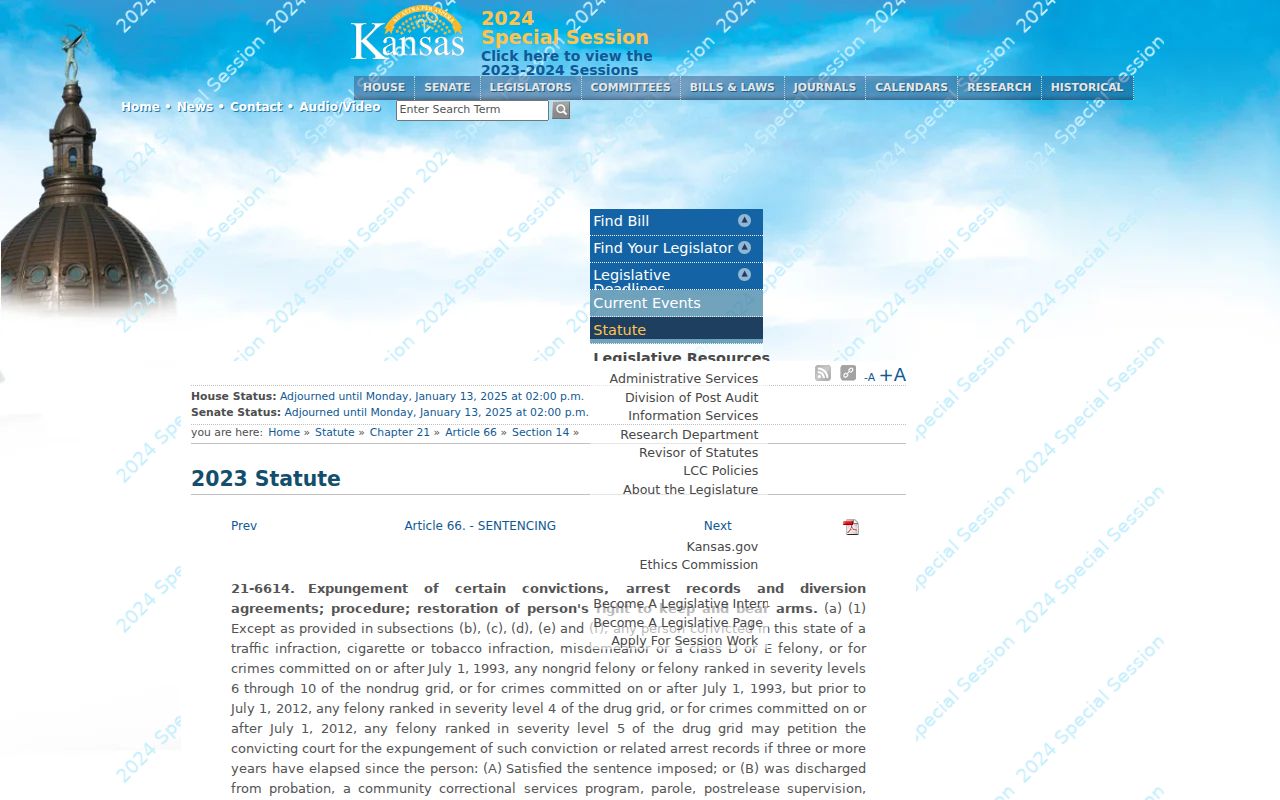
The statute source anchors any eligibility discussion to Kansas law rather than to a broad promise that a record can be removed.
The separate K.S.A. 22-2410 arrest-expungement source appears in the next image.
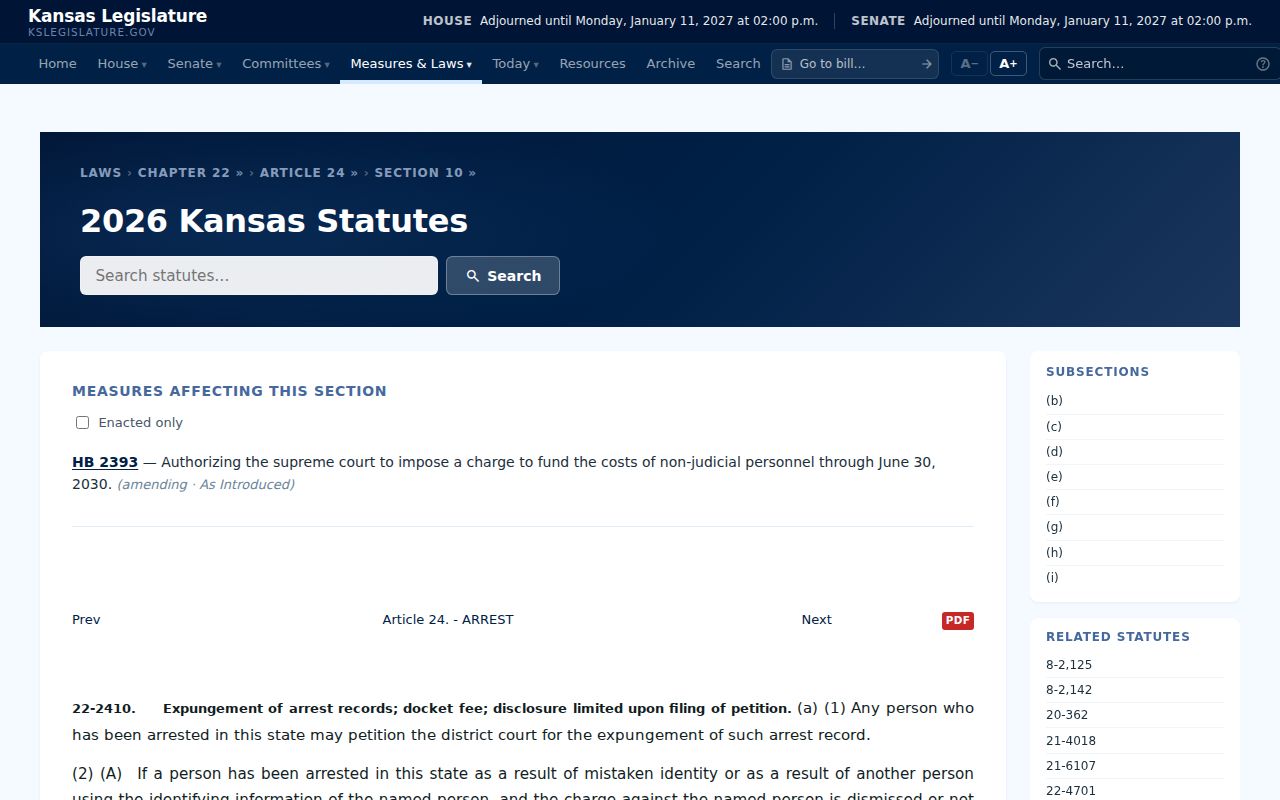
Keeping arrest and conviction relief separate prevents the wrong Kansas petition route from being used.
Kansas Criminal Record Access
Kansas Supreme Court Rule 22 governs public electronic access to district and appellate case records. K.S.A. 45-218 requires an agency to act on a records request as soon as possible and by the end of the third business day. That is a response deadline, not guaranteed production within three days. The response may provide records, deny with a basis, seek clarification or payment, or state when production is expected.
Juvenile and child-in-need-of-care cases, grand-jury material, subpoenas, protected identifiers, some investigative records, and sealed or expunged content can be unavailable. Redaction releases the segregable public part while withholding protected details. A person who needs a restricted file must use the authorized party, counsel, clerk application, or court-motion process instead of treating a missing portal result as proof no case exists.
KBI Kansas Criminal History
The KBI Kansas Criminal History Record Search is the statewide repository route for lawfully disseminated Kansas arrest and disposition submissions. It is not a multi-state federal check, and it does not supply every complaint, motion, or county PDF. A name result can conflate people or miss an alias. Fingerprints are the stronger identity method, and regulated fingerprint checks require the proper program authority, consent, and submission route.
The KBI criminal-history program page explains request routes and dissemination limits. Its official sample Kansas history report shows names and aliases, demographics, arrest cycles, court charges, disposition dates, sentences, and corrections entries. The sample also warns that fingerprints identify people more reliably than names and that the report is not a collection of county pleadings or police narratives.
| Search control | Use | Requirement or caution |
|---|---|---|
| Account or guest path | Select the service entry route | Availability depends on the current service |
| First and last name | Starts a name-based check | Legal name is required; common-name matches need care |
| Middle name and birth date | Narrows identity | Middle name is optional; birth date is ordinarily key |
| Sex and race | Further match controls | Use only the live categories and a lawful purpose |
| Continue and payment | Submits the official transaction | Verify the live total before ordering |
The official KBI criminal-history service is captured in the next source image.
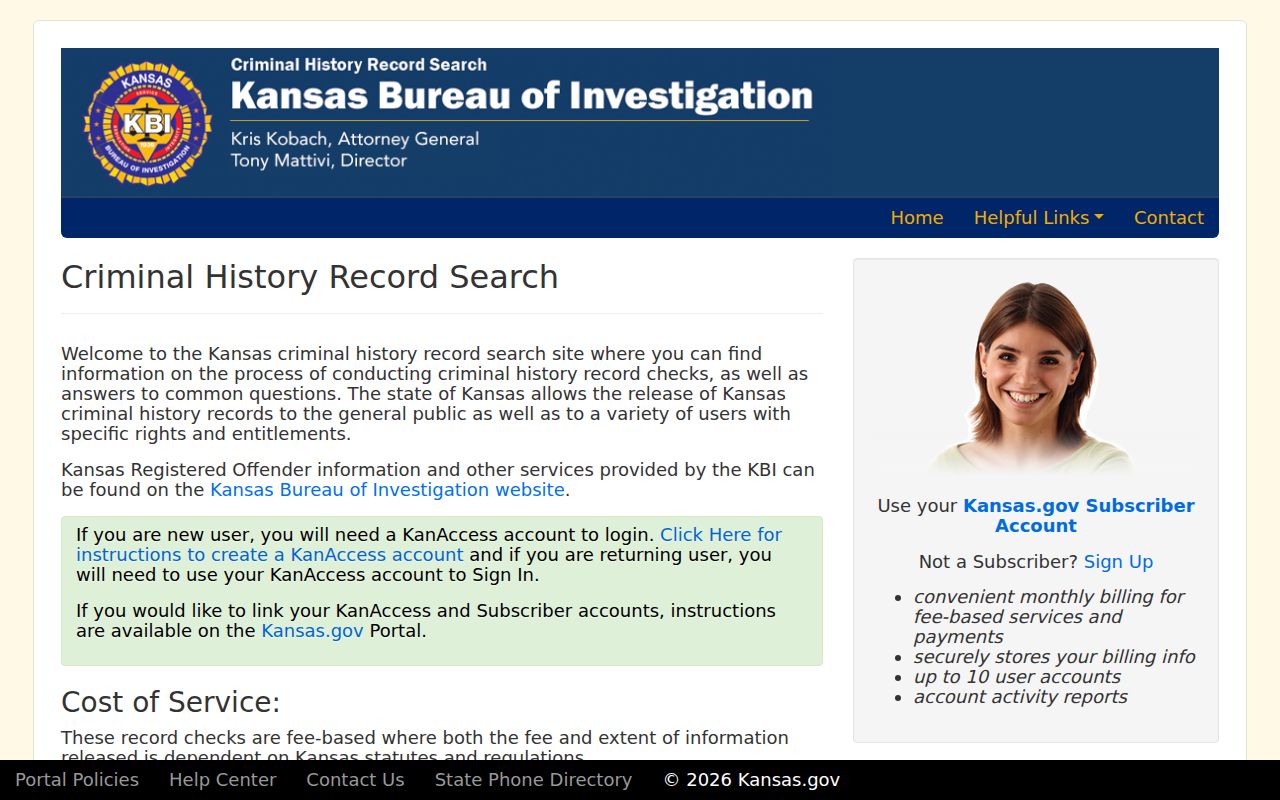
The KBI route is best for a compiled Kansas history; the filing clerk remains the source for certified case documents.
A KBI report should be read as an event cycle: arrest agency and allegation, court charge and case, disposition, sentence, and corrections information. If an entry is wrong, obtain certified proof from the court and follow the KBI challenge process. The court corrects its record; KBI corrects its repository submission. Neither custodian can casually rewrite the other's data.
Current Kansas Criminal Relief
Kansas legislation effective July 1, 2025 added automatic relief 30 days after acquittal or dismissal of all charges in described cases unless an appeal, defendant objection, prosecutor objection, or statutory exception applies. It does not mean every old dismissal vanished. The docket and current statute must confirm whether an order was entered. The Kansas Judicial Branch expungement resources provide the official form routes. Pending 2026 proposals are not enacted law.
The official HB 2655 legislative history provides the source for that effective change.
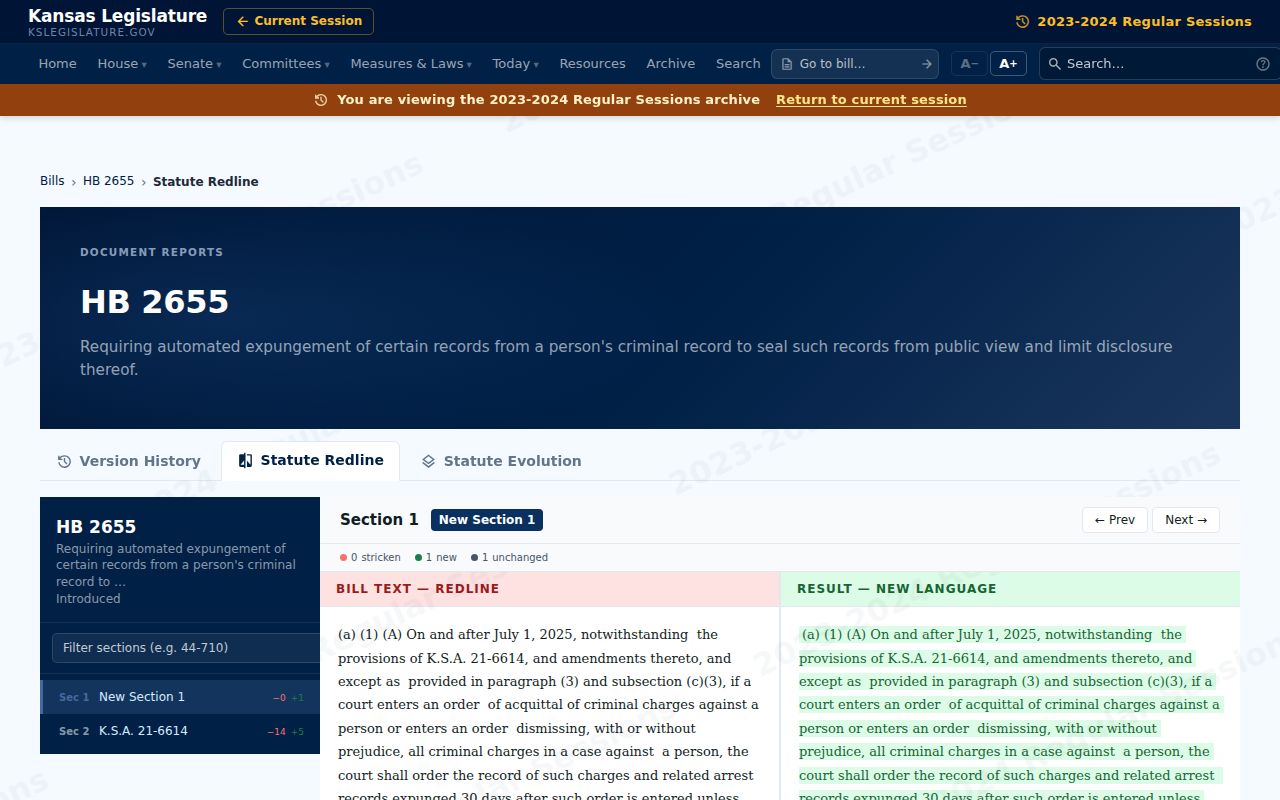
The legislative source helps distinguish the enacted Kansas provision from later proposals that have not become law.
For any petition or certified disposition, choose the county where the state case was prosecuted. Supply the exact case number, caption, filing date, and requested document, then ask the clerk to identify any copy or certification cost before work begins. A narrow request can also ask for segregable public portions and the legal basis for any withholding. This county route is the final authority when a portal record is incomplete.
Note: Kansas criminal case status can change after appeal, revocation, correction, or expungement, so verify the current signed order with the filing clerk.