
Kansas Inmate Records by System
Kansas custody begins locally in most cases. A county jail may hold a person after arrest, on a warrant, before trial, while serving a local sentence, or while awaiting transfer. The sheriff is the record custodian. By contrast, the Kansas Department of Corrections, or KDOC, records people sentenced to the Secretary of Corrections and people under KDOC supervision. A recent arrestee will normally not appear in the state prison repository. After a transfer, the county roster may stop showing that person even though the state profile has not yet caught up.
Other placements require other sources. Federal prisoners use the Federal Bureau of Prisons system. Interstate-compact placements may fall outside public KASPER coverage. City holding, immigration detention, hospitals, and juvenile custody are not combined in either Kansas system. The same person can move from police holding to jail, court, KDOC intake, prison, work release, and parole. Search results should therefore be read as a dated custody snapshot.
Custody dates must also be labeled with care. Arrest, booking, court filing, sentence, KDOC admission, transfer, release, postrelease supervision, and discharge mark different events. A county booking record proves detention at intake, not guilt. A court journal entry proves the recorded disposition or sentence. KASPER describes corrections status. Combining those sources without preserving their dates and roles can create a false timeline.
Note: Search the custody system tied to the person's current stage, then use the court record to verify the legal outcome.
Search Kansas KASPER Records
The Kansas Adult Supervised Population Electronic Repository, known as KASPER, is KDOC's statewide offender locator. It covers people sentenced to KDOC custody since 1980 who are incarcerated, supervised, or discharged. KDOC states that people sent under interstate compact are excluded. The repository updates daily except weekends, so a court order, transfer, or release may not appear at once. It is not a county booking or bond database.
The KDOC locating explanation documents KASPER's coverage and profile fields.
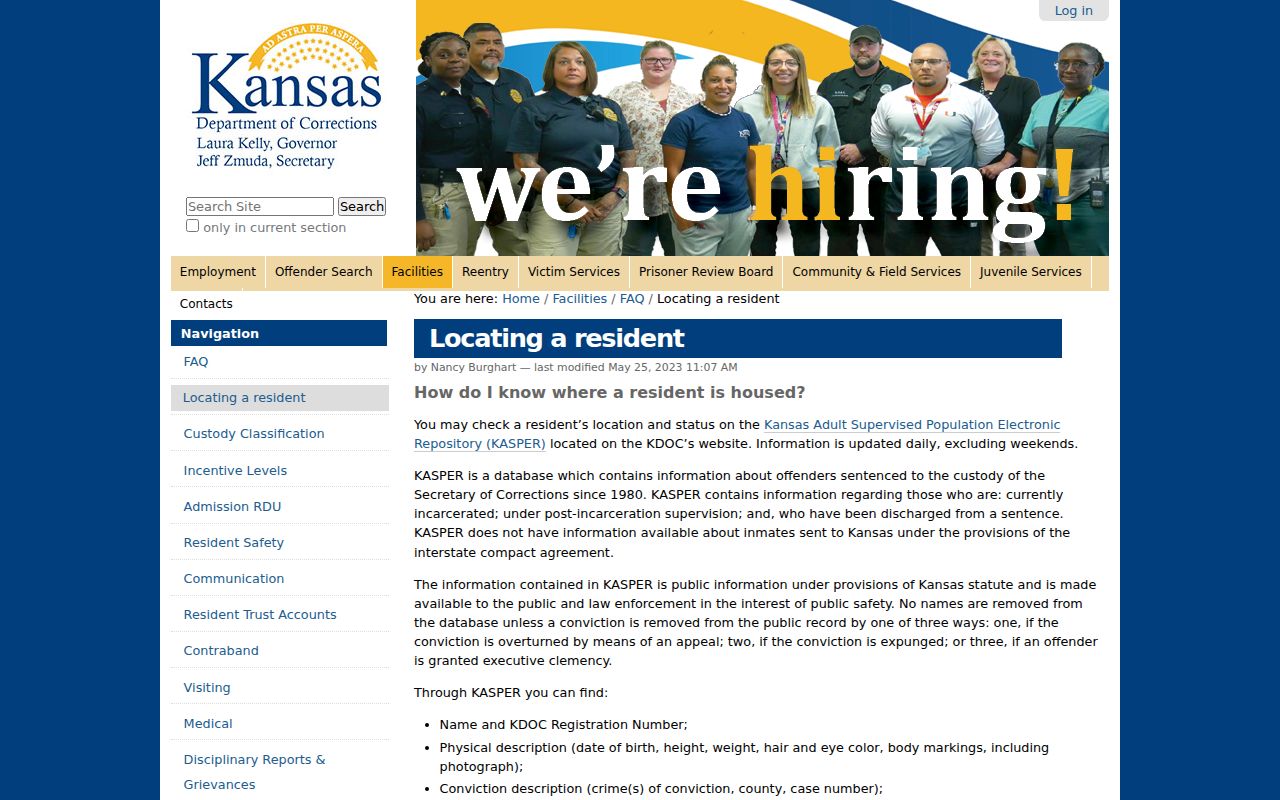
The official explanation is the best place to check update timing, exclusions, and the meaning of an anticipated release date before relying on a profile.
- Open KASPER and search by KDOC number when it is known. That unique number is stronger than a name.
- Otherwise enter a legal last name, then add first or middle name to narrow results.
- Compare name, photograph, date of birth, physical details, and conviction county before identifying a match.
- Open the profile and note whether it says incarcerated, supervised, or discharged. Record the date checked.
| Search Field | Type | Required | Use |
|---|---|---|---|
| KDOC Number | Text | Alternative | Strongest exact identifier |
| Last Name | Text | Name path | Use the legal surname |
| First / Middle | Text | Optional | Narrows common-name results |
| Search / Reset | Control | Search needed | Terms or a captcha may appear |
County jail or state prison? A KASPER no-result may mean the person remains in local custody. Use the Kansas county directory to reach the arrest or holding county's sheriff.
Read a Kansas KASPER Profile
KASPER profiles can identify the person by name and KDOC number, photograph, birth date, physical description, and body marks. Corrections fields may show incarceration, supervision, or discharge; conviction offense, county, and court case; housing and movement history; parole office and supervision type; disciplinary findings; and an anticipated release date. These fields serve different purposes. The corrections offense label is not the full court case, and a movement record does not reveal the reason unless KDOC separately publishes it.
| Profile Field | Meaning and Limit |
|---|---|
| Name and KDOC number | Identity label and unique corrections identifier |
| Status and location | Current configured custody, supervision, or discharge entry |
| Conviction and case | Corrections summary that can route to the sentencing court file |
| Anticipated release | Credit-dependent estimate, not a guaranteed release date |
| Movement and supervision | Housing changes, parole office, or supervision type when displayed |
| Disciplinary findings | Administrative prison findings, not new criminal convictions |
Credits, forfeitures, detainers, new court orders, and sentence recalculation can change release estimates. Parole eligibility, conditional release, postrelease end, and final discharge are not synonyms. KDOC lists Sentence Computation at 785-296-3317 for a calculation question. The sentencing journal entry remains the legal source for the sentence itself.
Note: A discharged KASPER entry is historical repository coverage and does not mean the person is now held in a Kansas facility.
Search Kansas County Jail Rosters
Kansas has no single public roster that merges all county jails. Sheriffs may publish a searchable site, vendor application, recent-booking list, PDF, or only a telephone route. A local roster often covers active or recent detention, not a permanent booking archive. Start with the county of arrest or current holding. If the record has disappeared after release or transfer, ask the sheriff for an existing booking sheet, release record, roster entry, or bond list.
The official Sedgwick County detention search gateway identifies the county's public roster route.
The official Sedgwick County jail search is a useful example of a county roster, but it is not statewide.
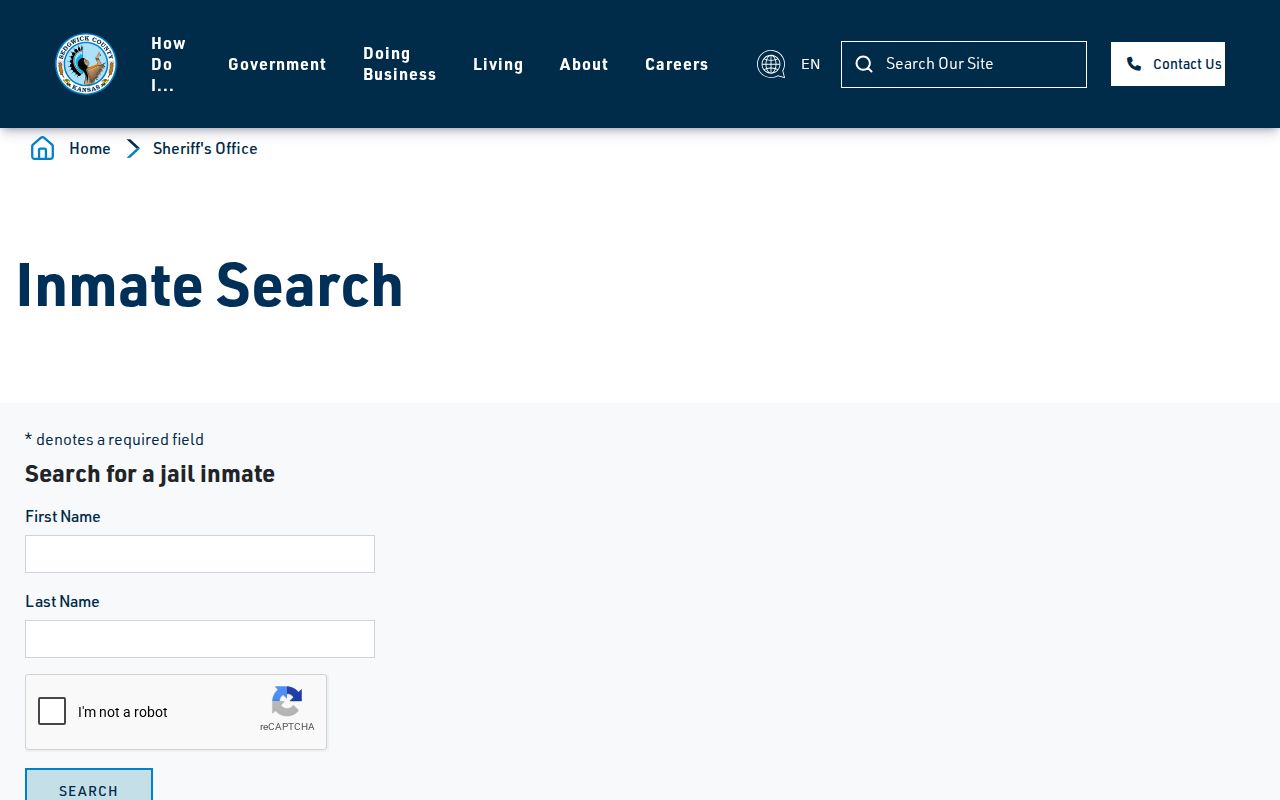
Its name and booking-number controls show the kind of local search that varies from one Kansas sheriff to the next.
| Field Label | Type | Required | Notes |
|---|---|---|---|
| Last Name | Text | Name path | Use exact legal spelling and known aliases |
| First / Middle Name | Text | Optional | Helps narrow common surnames |
| Booking Number | Text | Alternative | Best local identifier when known |
| Search / Reset | Control | Search needed | Available controls depend on the county |
Kansas Jail Profile Fields
A Kansas jail profile commonly shows a legal name, booking number and date, photo or demographics, arresting agency, housing or status, booking charges, court, bonds, holds, and release information. Display choices differ. A roster may omit a birth date, address, victims, medical or classification data, housing details, judge, or sealed counts. Medical screening and security classification are generally not ordinary public roster fields.
| Field | What It Shows |
|---|---|
| Booking number and date | Local intake identifier and custody start date |
| Agency and status | Booking authority and current roster label |
| Charge and court | Intake allegation and the court tied to that line |
| Bond and holds | Terms shown per case or hold, not always an amount that can be totaled |
| Housing | Published facility or unit, if the sheriff displays it |
| Release | Date, reason, or destination when the roster makes it public |
A booking charge records the intake allegation. Filed court charges can change after prosecutor review. A bond line may be cash, surety, recognizance, supervised, or no bond, and another hold can still prevent release. For the operative allegation and result, compare the roster with the filed Kansas arrest and charge record.
Track Kansas Custody Changes
The Kansas VINELink interface supports custody searches and registration for participating-agency alerts.
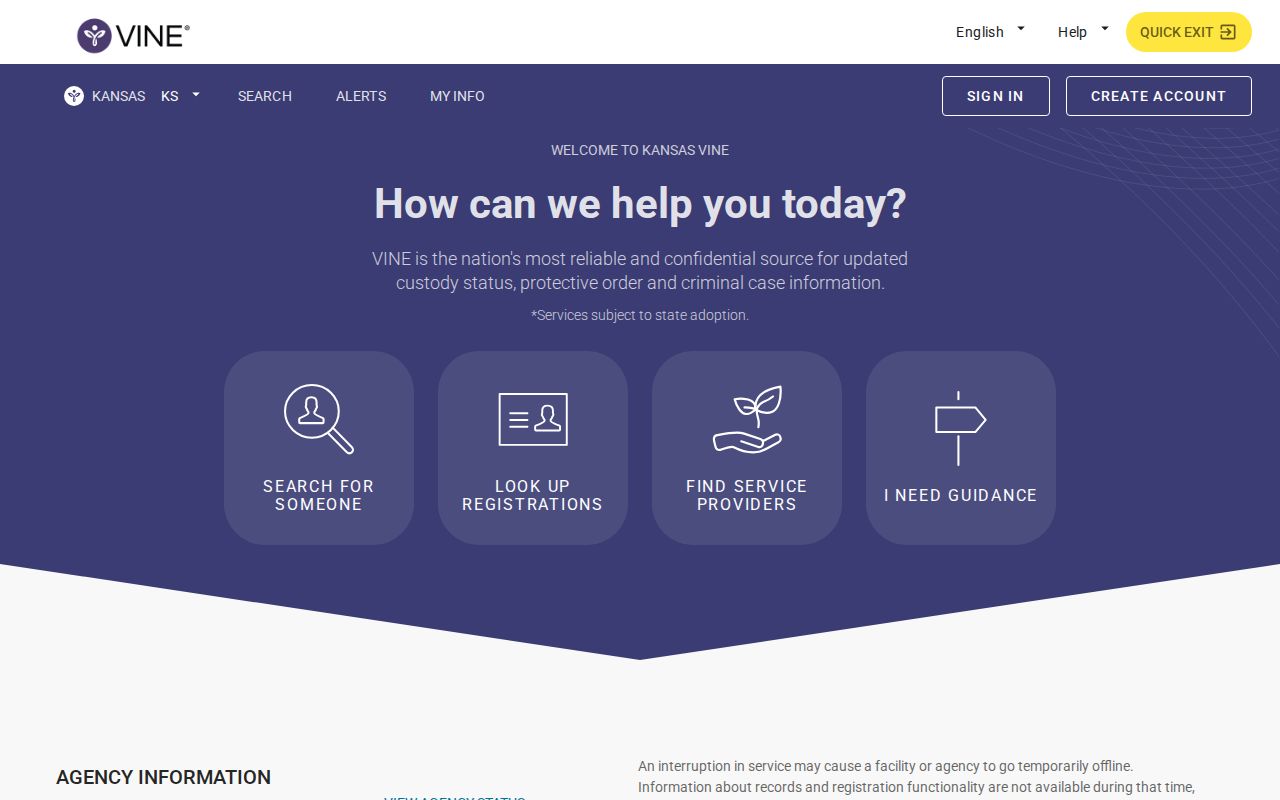
VINE can report configured release, transfer, escape, or status events, but it does not certify a court outcome and does not replace direct safety planning.
Victims may select the voice, text, email, or PIN options currently offered and must keep contact details current. Prosecutor and court notices about hearings, pleas, or sentencing are separate from VINE. KDOC victim services is another corrections-stage channel. Never place private registration details in a public records request.
During a transfer, check both the jail and KASPER. A jail status of released can mean bond, sentence completion, a court release, transfer, or pickup by another agency. Read any destination or reason that is public, then confirm with the holding agency.
Note: VINE is a notification service, not an emergency system, complete historical roster, or certified source for court disposition.
Kansas Inmate Visits and Contact
Visitation rules come from the current facility, not a statewide jail schedule. County jails may offer in-person or vendor-run video visits. A KDOC visitor may need an application and background approval. Identification, dress, age, scheduling, suspension, victim status, protection orders, and probation conditions can affect access. Always verify the current location first because a move may invalidate a reservation or change the approved vendor.
| Custody Setting | Schedule Source | Confirm Before Contact |
|---|---|---|
| County jail | Current sheriff or detention page | Day, time, in-person or video, ID, approved list |
| KDOC facility | Current KDOC facility page | Visitor approval, session, rules, suspension status |
| Remote video | Facility-linked official vendor | Account, fee, device, cancellation terms |
| Legal visit | Facility legal-access procedure | Credential, appointment, confidential channel |
Mail requires the exact legal name and booking or KDOC number. Legal mail follows a different protected process. Calls and ordinary messages may be monitored. Commissary and trust deposits also require the correct identifier. Verify the vendor on the facility's own page, especially after transfer, and never pay an unsolicited caller who promises release.
Request Kansas Booking Records
When no useful roster is online, call or visit the sheriff, send a focused mail or email request, or seek an existing public record under K.S.A. 45-218 of the Kansas Open Records Act. Provide the legal name, aliases, birth date if lawfully used, booking number, arrest date, agency, and county. Ask for a named item such as the booking sheet, release record, roster entry, or public bond history. A narrow request reduces cost and avoids asking for private or investigative material that the custodian must redact or withhold.
Incident reports, active investigation material, victim information, medical data, classification, and jail-security records may receive different treatment. Ask for segregable public fields when part of a record is restricted. A photograph is not guaranteed to be online merely because a roster exists. The custodian can explain retention or whether an older record has been archived.
Note: A name match alone does not prove identity; compare stable numbers, dates, photographs, and the official court or custody source.
Federal Inmates in Kansas
The Federal Bureau of Prisons inmate locator is separate from Kansas inmate systems.
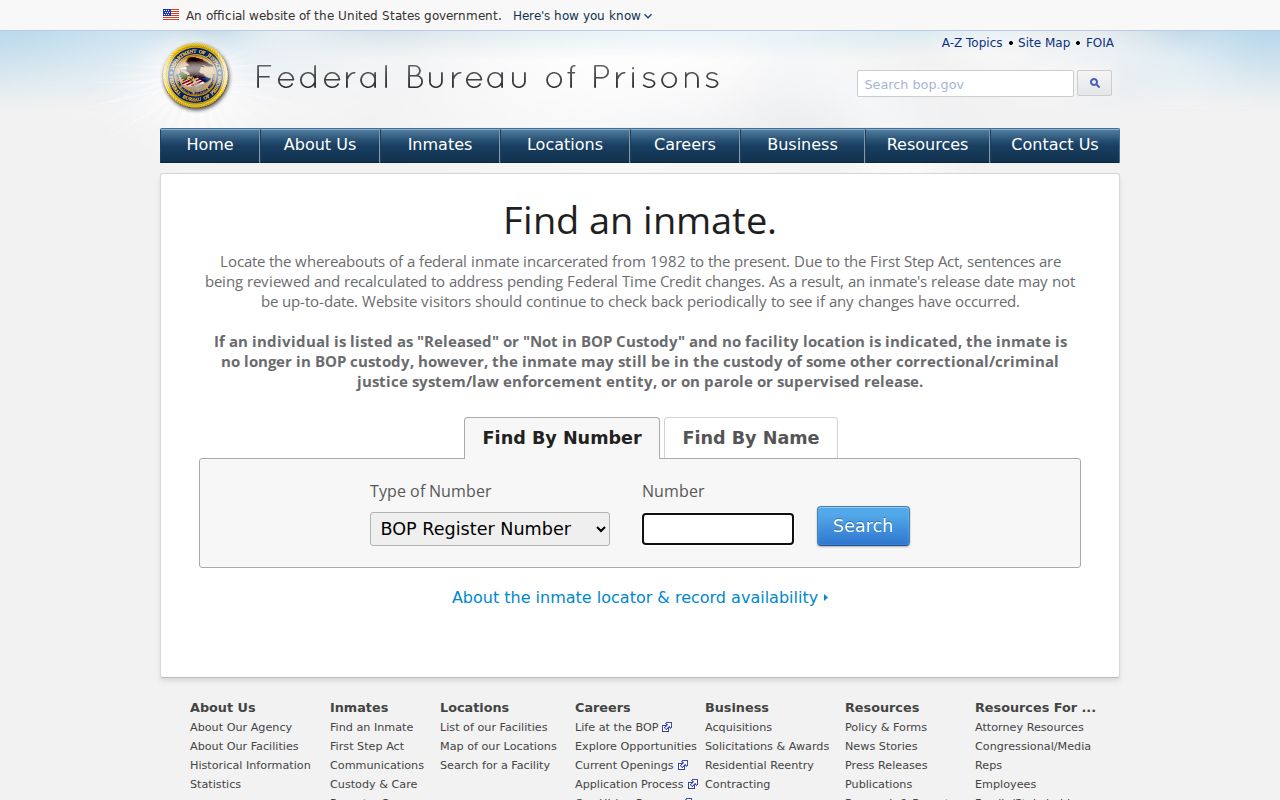
Use it for a person in federal BOP custody. A federal defendant may instead be in a county jail under a U.S. Marshals hold before transfer, so the local sheriff and federal case source can still matter.
KASPER may never show a federal prisoner. Likewise, the BOP locator does not replace a Kansas jail search, KASPER profile, immigration inquiry, or another state's corrections locator. Match the record system to the agency that actually has custody.
Note: A person held for federal authorities may appear in a local jail before any later Federal Bureau of Prisons placement.
Find Kansas County Jail Facilities
Local custody questions must end at the correct sheriff. Choose the county of arrest or holding in the Kansas county directory, open its official jail information, and confirm the roster, facility address, telephone route, visitation rule, mail format, and deposit vendor. If the city or county is unknown, use the citation, arresting agency, court case, KASPER conviction county, or other official document before guessing.
Roster retention also changes by Kansas county. An active-only search may stop displaying a person after release, while another sheriff may keep a recent-booking list. Ask whether an older booking sheet or release record is retained, archived, or available through a focused public-record request. Confirm local hours and time zone before a visit because far-western Kansas counties observe Mountain Time while most of the state uses Central Time.
No one search covers county jails, KDOC prisons, federal custody, interstate placements, immigration detention, hospitals, and city holding. The most reliable chain is the correct official database, direct facility confirmation, a narrow record request when needed, and a court record for filed charges or sentence proof.